The forest has been awake for hours by the time the gates open.
Mist still hangs in the deeper hollows. Chital feed along the edge of a meadow, lifting their heads every few minutes before lowering them again.
A langur sits high in a teak tree, its tail falling through the branches like a length of grey rope.
Somewhere beyond the road, hidden behind bamboo and shadow, a peacock calls.
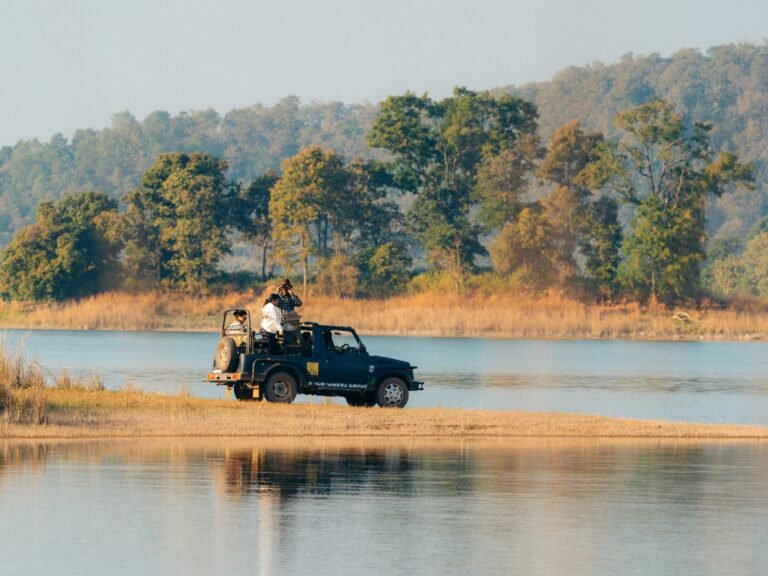
The jeep rolls forward slowly. Then the guide raises a hand. There are pugmarks in the dust. Fresh ones.
The pads are still sharply defined, the edges not yet softened by tyres or wind. A tiger has walked along this road recently, perhaps before sunrise, perhaps only minutes before the first vehicles entered.
Suddenly every bend matters.
We follow the tracks until the road dips through a dry stream and turns towards a wall of bamboo. For a while the tiger has used the same path available to us.
Then, without ceremony, the prints turn away from the road and disappear beneath the trees.
That is all it takes.
A two-hundred-kilogram predator has gone from being somewhere in front of us to being almost anywhere.
Four hours later, we leave the reserve without seeing it.
For someone on a first tiger safari in India, this can seem almost impossible.
There are tigers in this forest. We know that.
- The pugmarks were fresh.
- Perhaps sambar called somewhere beyond the road.
- Perhaps another vehicle glimpsed the animal earlier that morning.
So how can you spend one safari, two safaris, even four safaris inside excellent tiger country and still not see a tiger?
If you have ever driven out of a gate thinking, “But everything was pointing to a tiger,” this probably sounds familiar, doesn’t it?
The answer lies less in how many tigers a forest holds than in how a tiger occupies that forest.
Space. Cover. Time. Season. Individual behaviour. And chance.
Put them together and the mystery begins to make sense.
A Tiger Reserve Is Not a Tiger Enclosure
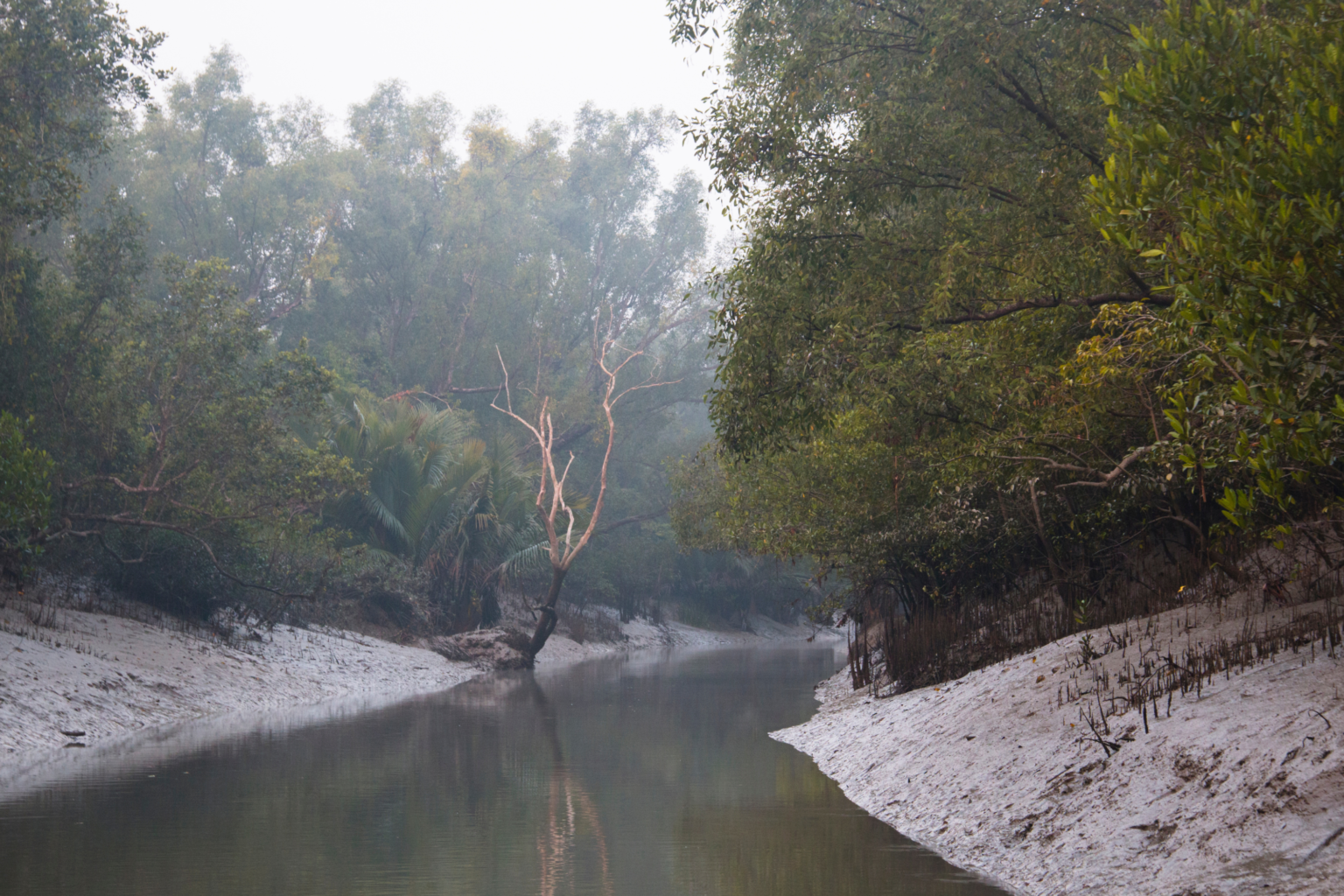
The first mistake is to imagine that entering a tiger reserve means entering the space occupied by all its tigers. It does not.
A tiger reserve is a vast living landscape.
Forest, grassland, water, hills, riverbeds, villages, buffer habitat and corridors may stretch across hundreds or thousands of square kilometres. Within that landscape, tourists travel only through designated areas and along designated roads.
That restriction is intentional.
India’s National Tiger Conservation Authority places conservation above tourism and recommends that tourism remain limited to a relatively small proportion of critical tiger habitat.
A reserve exists first so that a tiger can live as a wild tiger should. Our ability to enter parts of that landscape is secondary.
That distinction changes everything.
A safari vehicle follows a road. A tiger follows geography.
It may walk the road for half a kilometre, step into bamboo and continue along a nullah no vehicle can enter. It may cross from one tourism route to another through several kilometres of inaccessible forest. It may spend the entire morning beside a water source hidden beyond the part of the reserve open to visitors.
The animal can be close enough for a sambar to smell it and still be completely beyond our world.
When someone says, “We searched the entire zone,” what they usually mean is that they searched the roads available inside that zone. The forest between those roads remains the tiger’s.
A Line on a Map Is Not the Tiger’s World
Researchers like neat boundaries. A home range can be plotted on a map, measured in square kilometres and drawn as a tidy shape.
The tiger has no obligation to make that shape feel tidy to us.
Inside that range, some places matter far more than others. A shaded nullah may be used repeatedly. A waterhole may become important in summer. One tree may carry scent marks for months. Another patch of forest, technically inside the same territory, may barely be visited at all.
This is worth remembering on safari because we often talk about a tiger as though knowing its territory should tell us where it is. It doesn’t. It only tells us the country the animal knows.
A tigress with cubs may use that country very differently from a territorial male. A dispersing youngster may behave differently again.
The map tells us where a tiger can be. It does not tell us where the tiger has chosen to be today.
And that is why tiger density is not the same thing as tiger visibility.
The Places a Tiger Remembers
In September 2026, researchers studying tigers in Panna asked an interesting question: not simply where did the tigers go, but where did they keep returning?
GPS data from twelve resident tigers showed that certain places were revisited repeatedly. Water, vegetation, canopy, terrain and season all played a role. But one of the strongest messages from the study was that individual tigers behaved differently.
There was no universal tiger formula.
That sounds obvious when you say it out loud, doesn’t it? Yet safari conversations often treat every tiger as though it should behave like the last one.
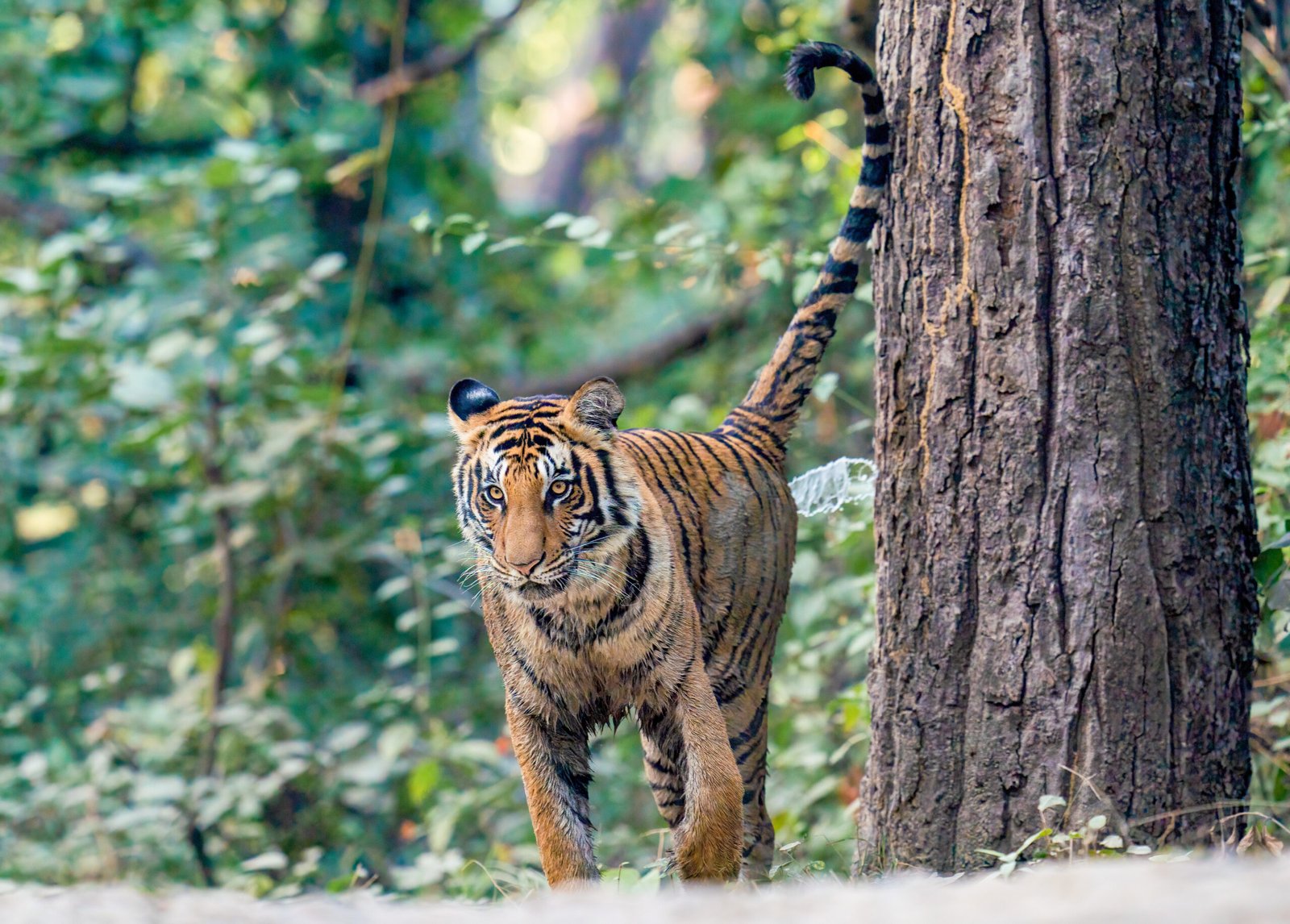
Anyone who spends enough time in the forest begins noticing these patterns. A particular stream crossing keeps producing pugmarks. One tree is sprayed repeatedly. A shaded bend seems to matter to one animal far more than another.
But remember, we only ever see fragments of that life.
We are trying to reconstruct a probable story from clues left behind by an animal that knows this landscape infinitely better than we do.
There is always an animal inside the data.
Sometimes the Tiger Chooses the Road
There are mornings when the tiger makes our work easier because it walks where we can follow.
Forest roads, fire lines and dry streambeds can offer easier passage through dense vegetation. Researchers use the same clue when placing camera traps: look first for pugmarks, scrapes, scent marks and routes animals are already using.
A safari guide does much the same thing in real time, and after a few drives you begin doing it too. Fresh tracks matter because, briefly, the tiger has entered a space that both animal and vehicle can use.
But even fresh tracks tell only part of the story.
A tiger may walk a road at 4:00 a.m., then sleep a hundred metres away until noon. It may step into grass so dense that three jeeps can pass without anyone seeing the curve of its back. It may hear approaching engines long before we know it is there and simply continue deeper into cover.
A pugmark is evidence. It is not an appointment.
There is an entire language around those clues, and learning to read it is part of what makes safari so absorbing.
How a Tiger Disappears
Perhaps the most remarkable lesson comes when you finally see one.
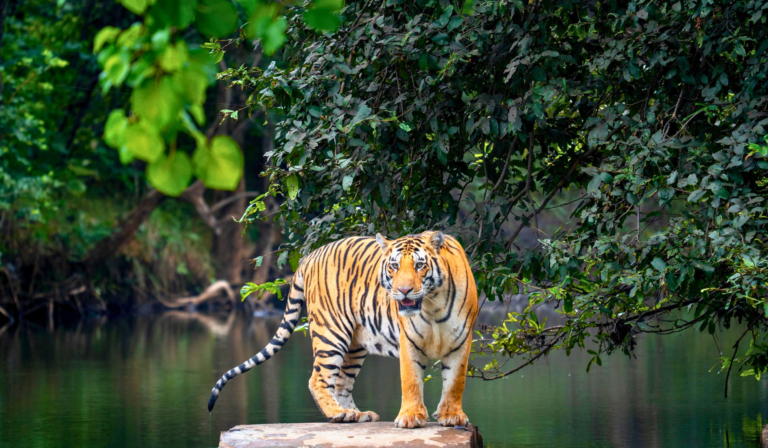
A tiger steps onto an open road and suddenly seems impossibly conspicuous. Orange against brown earth. White cheeks. Black stripes. A muscular animal large enough to dominate the landscape around it.
How could something like this ever be difficult to find?
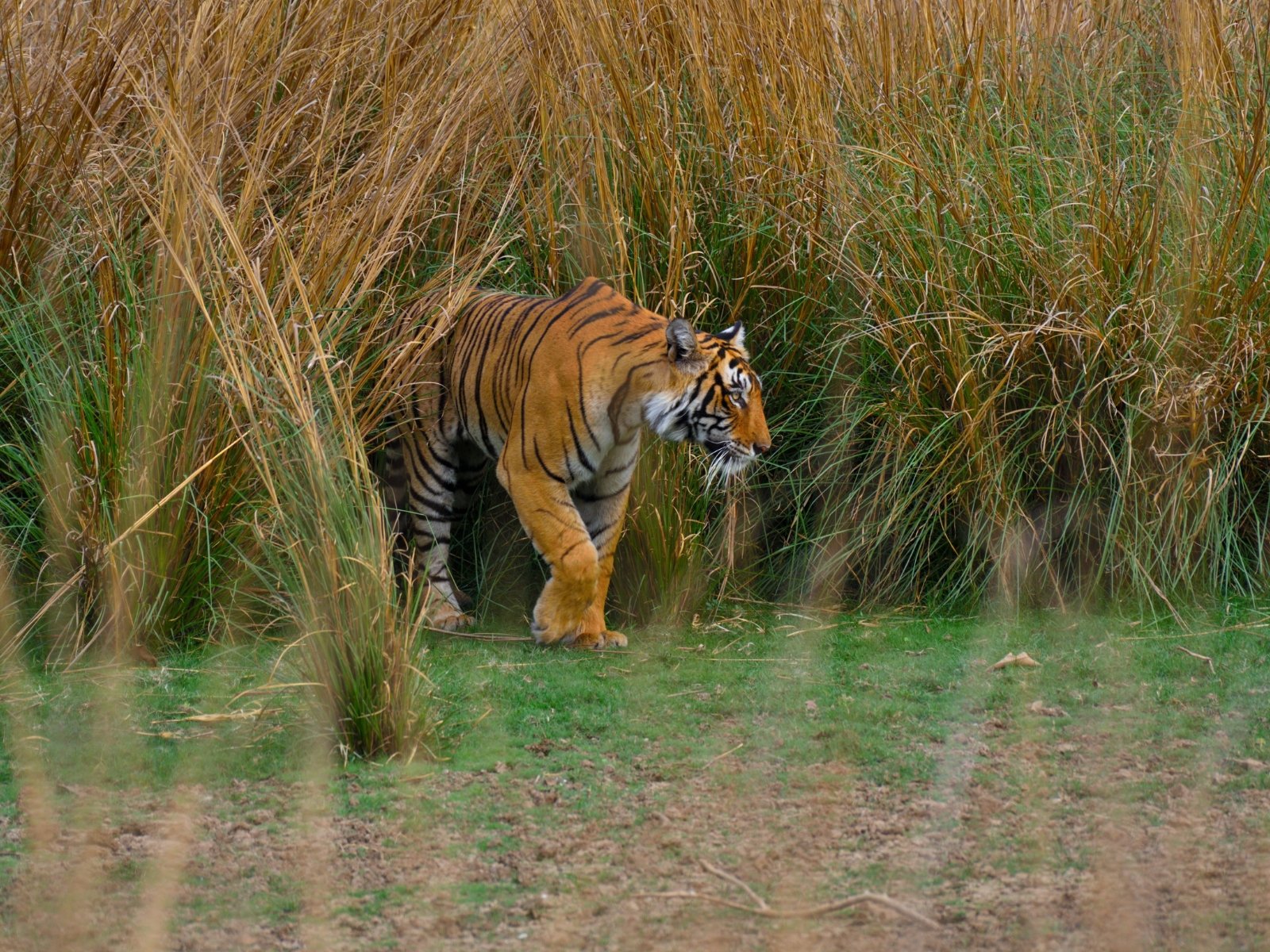
Then it walks into the grass. Within seconds, the answer becomes obvious.
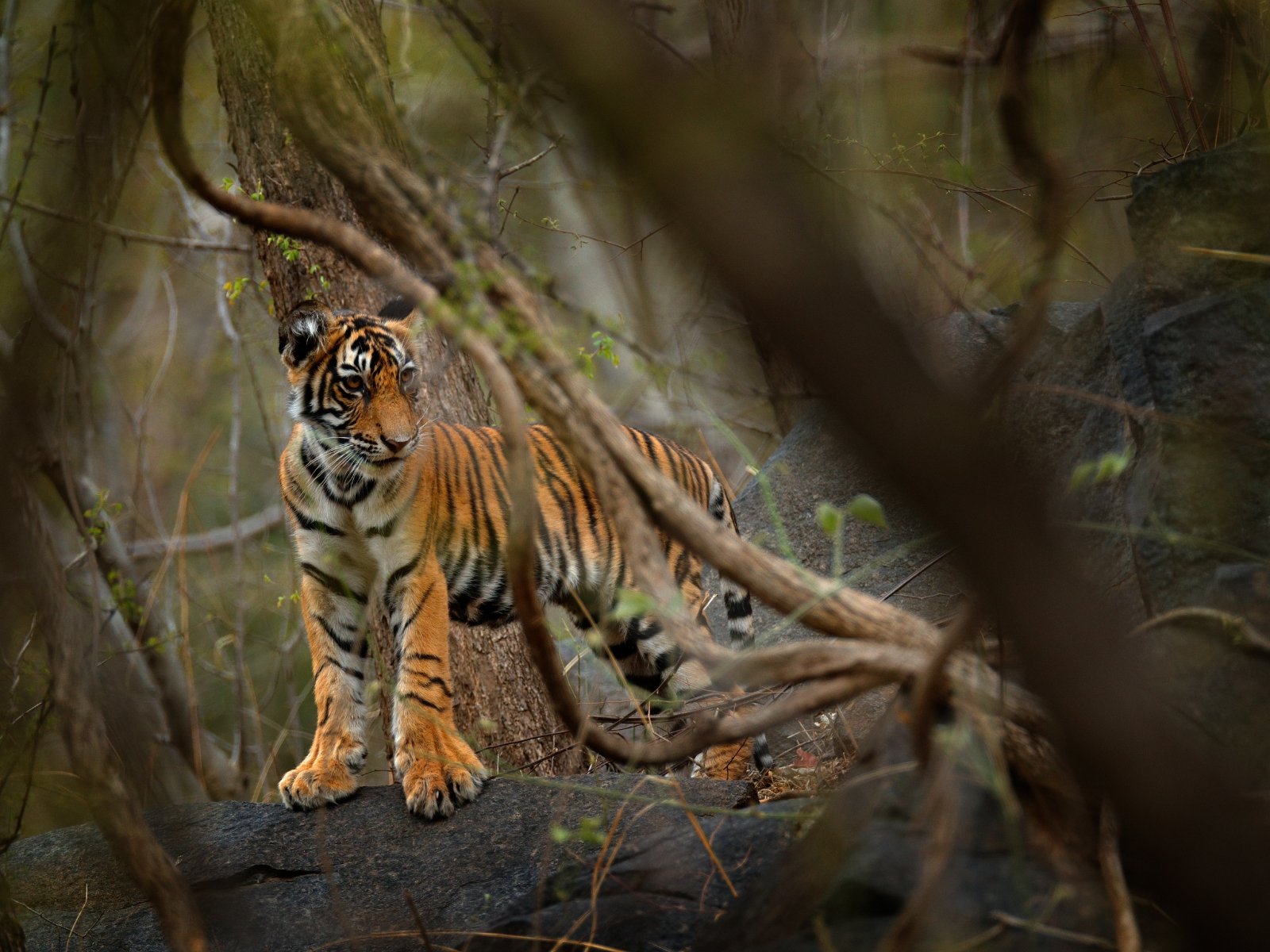
The outline begins to fracture. Stripes merge with stalks and shadows. The shoulder disappears first, then the flank. For a moment the head remains visible between stems, and then the forest closes over it.
The tiger has moved perhaps twenty metres. It is gone.
Camouflage is often discussed as colour, but in a tiger it is equally about the destruction of shape. The stripes break a large body into pieces, particularly in forests filled with vertical stems, alternating sunlight and deep shadow.
This is why visibility can change dramatically within the same safari. One stretch of road opens onto grassland where an animal can be seen hundreds of metres away. Around the next corner, bamboo may reduce that distance to twenty.
And if twenty metres of grass can hide a tiger, imagine what an entire season can do.
The same road can behave like two completely different habitats depending on when you visit:
- Summer opens the forest. Leaves fall, water retreats and sight lines lengthen, but heat begins to govern movement.
- The monsoon closes it again. Grass rises, bamboo thickens, dry nullahs carry water and forests that were skeletal in May become layered and green.
The tiger is still there. The forest has simply learnt to hide it better.
Some Forests Give You Better Odds
All of this uncertainty does not mean every tiger safari feels equally uncertain.
Far from it.
We have been visiting Tadoba since 2009, and over those years the forest has repeatedly reminded us that some landscapes simply give you more opportunities than others.
The numbers support part of what we see on the ground. In the 2021 Phase IV monitoring of Tadoba-Andhari, 85 adult individual tigers were photographed and the population was estimated at 86, around 6.31 tigers per 100 square kilometres in the sampled landscape.
That matters.
But statistics are only part of why Tadoba can be so exciting.
In the dry months, the forest opens dramatically. Teak drops its leaves, sight lines stretch farther and water becomes concentrated in fewer dependable places. The clues can become easier to read: pugmarks on dusty roads, repeated alarm calls, movement around water and familiar crossings.
But Tadoba is not only a summer story.
Some of our most exciting tiger watching there has come in the monsoon, particularly in the buffers. In fact, Tadoba is one of those unusual reserves where the buffer zones can sometimes be more productive than the core.
The tiger, after all, has no idea which side of our administrative boundary is supposed to be the main event. It follows territory, prey, cover, water and opportunity.
After enough years in the same landscape, you begin to feel when a drive is changing.
Fresh pugmarks appear on a familiar road. A sambar calls from the same direction twice. You know an animal has been using one side of the landscape repeatedly.
Nothing has happened yet.
But the forest feels charged.
That moment is difficult to explain until you have experienced it: the tiger is still invisible, everyone in the vehicle is listening, and an ordinary bend in the road suddenly feels full of possibility.
Sometimes nothing follows.
And sometimes you turn that bend and there it is.
Bandhavgarh offers another example of how strong tiger numbers can shape opportunity. In the 2022 national assessment, the reserve was estimated at about 7.5 tigers per 100 square kilometres.
High density never becomes a guarantee. But some forests genuinely give you more chances for your route and the tiger’s route to cross.
You are not trying to eliminate uncertainty. You are trying to put yourself in a landscape where uncertainty is full of possibility.
Safari Hours Belong to Us, Not the Tiger
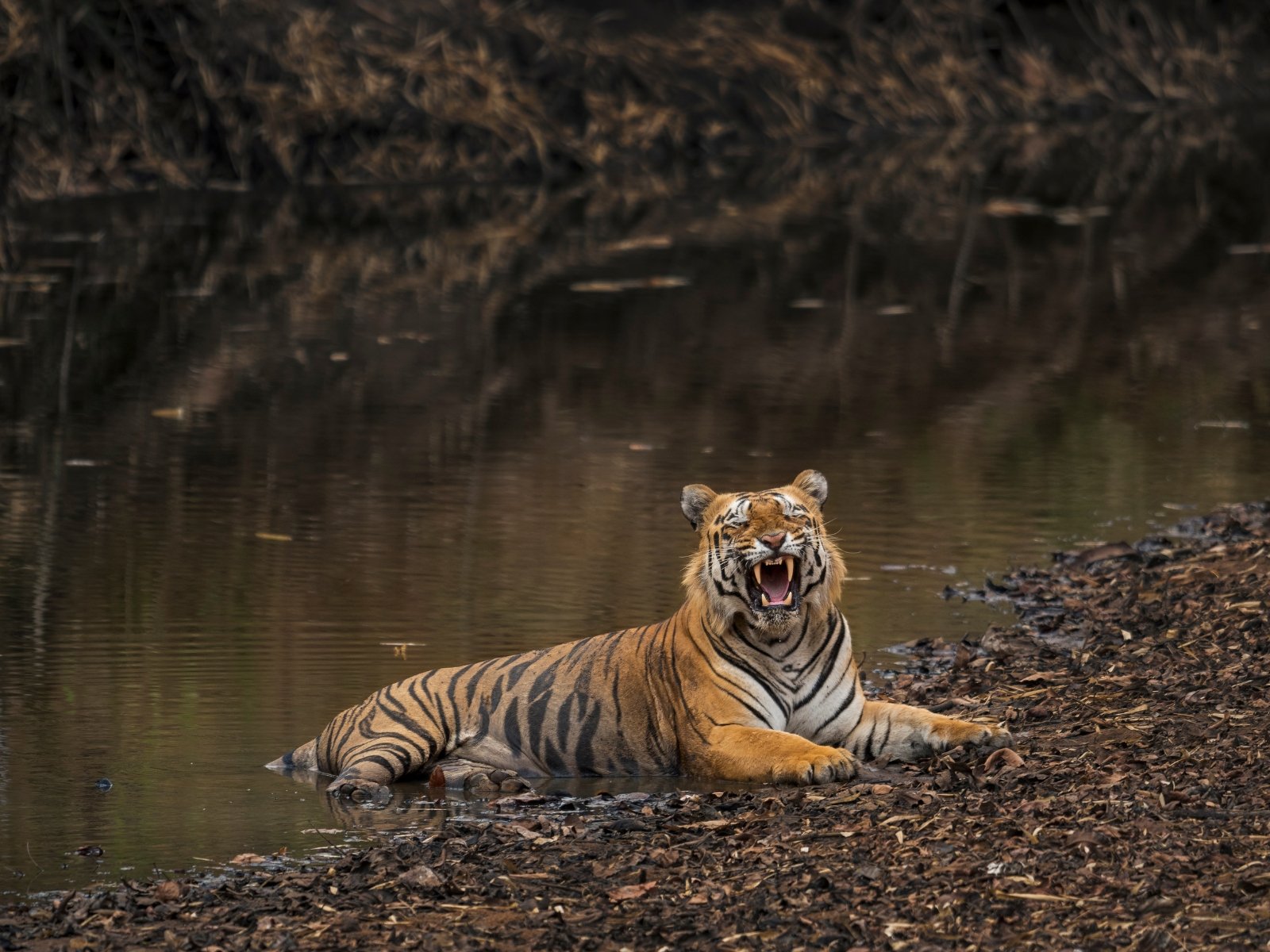
Imagine the forest at three-thirty in the morning. No vehicles. No engines.
A tiger walks slowly down the road, stops beside a tree and sprays. Farther ahead it leaves the track and slips into a dry nullah. Perhaps it has already fed, and by dawn it may be lying in bamboo beside a kill.
Then the gates open.
We enter and begin searching very seriously for an animal that may have finished its morning before ours began. There is something wonderfully humbling about that.
Gates belong to us. The timetable does not belong to the tiger.
Temperature matters. Hunger matters. A kill matters. Cubs matter. Other tigers matter. And sometimes, after all that reasoning, the animal simply does something that refuses to fit our neat expectations.
A forest is a system of tendencies. Not promises.
Four safaris therefore do not give us four complete days with a tiger. They give us four narrow windows cut into its life.
Occasionally, the animal walks through one of them.
The Forest Begins to Speak
This is where the naturalist becomes important and why we, at Safari Lab are very particular about who we work with, to accompany our guests.
A jeep cannot follow a tiger through the forest, so the forest itself becomes the tracker.
A sambar gives a resonant alarm call from somewhere in the sal. A chital stares into one patch of grass for too long. Langurs gather higher in the trees and look down. Fresh pugmarks cross the road. A scrape appears beside a familiar tree.
Each sign is incomplete. Together, they begin to form a direction.
The skill lies not merely in noticing these clues, but in judging their weight.
A single alarm call may mean very little. Repeated calls from the same place are different. Calls that slowly shift position suggest movement. Add fresh pugmarks heading in the same direction and the possibilities narrow further.
Sometimes the right decision is to follow. Sometimes the right decision is to stop.
The engine dies. For a moment, its absence is almost startling. The ticking of cooling metal fades. A drongo calls somewhere behind us. Leaves move in a breeze we had not noticed while driving.
Then the sambar calls again. Closer.
Waiting on safari can feel like doing nothing. In reality, it is often the moment when the forest becomes most alive.
If you want to understand what guides are listening for, read our detailed guide to alarm calls in Indian jungles.
Four Drives Are Not Four Copies of the Same Morning
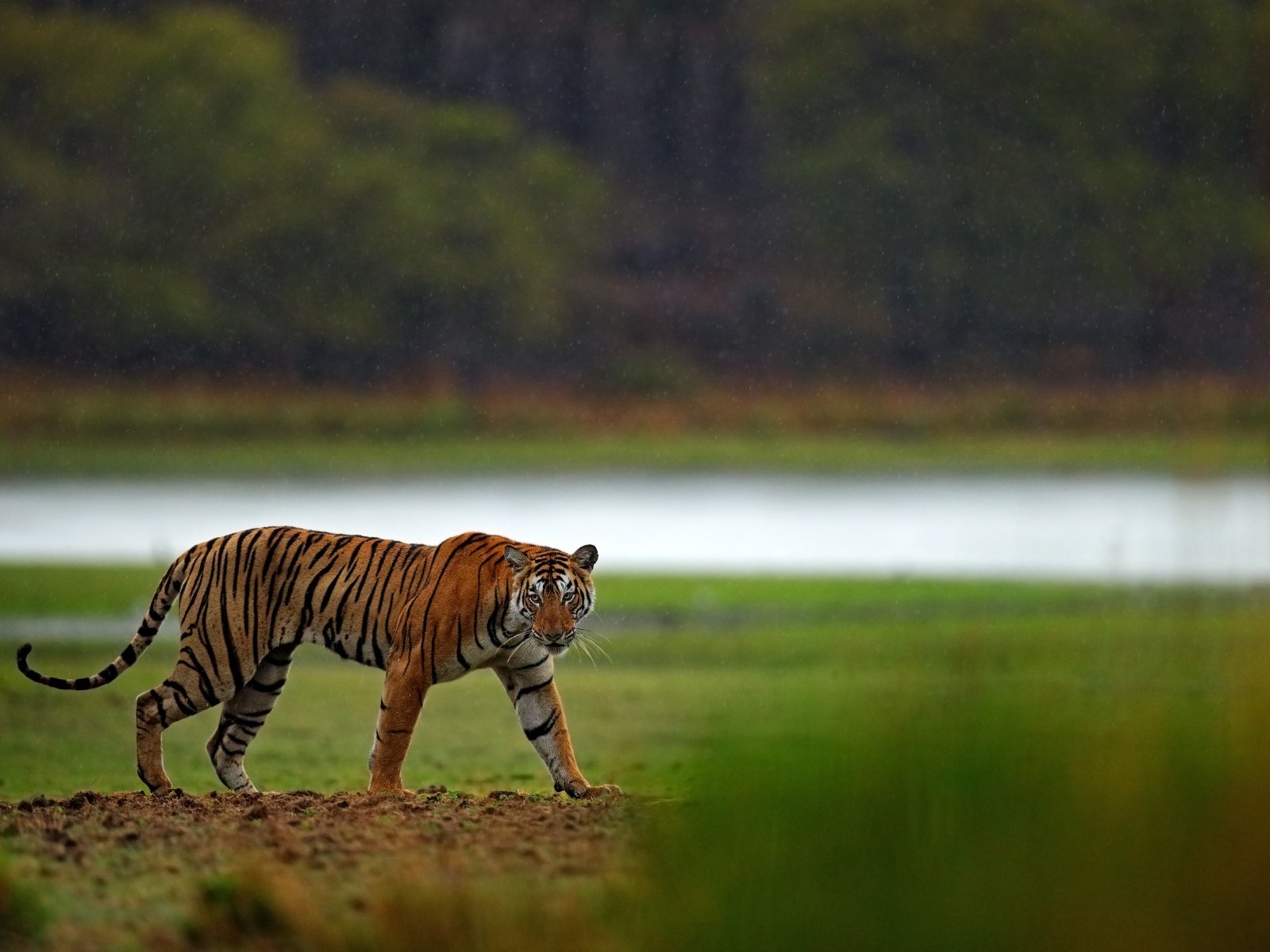
The forest you enter tomorrow will not be the forest you entered today.
Rain may fall overnight. A tiger may make a kill. A rival male may move through the territory. A tigress may shift her cubs. Prey may concentrate around water. A carcass may keep a predator in one place for hours.
The variables rearrange themselves constantly.
Even the same road changes with light. At dawn it lies grey beneath the trees. By afternoon it is a ribbon of white dust. At dusk, every patch of lantana becomes black enough to hide something.
This is why multiple safaris help.
Not because each drive represents another identical spin of a roulette wheel, but because every drive samples a slightly different version of the landscape.
Additional drives give you more dawns, more afternoons, different weather, fresh tracks and information carried over from the previous drive. Most importantly, they give the tiger’s route and yours more chances to intersect.
One drive can produce the sighting of a lifetime.
Sometimes the forest is astonishingly generous. A tiger may appear ten minutes after the gate opens. A tigress with cubs may emerge in the afternoon. A male may walk the road the next morning as though all our careful explanations about uncertainty were slightly unnecessary.
That unpredictability cuts both ways. More drives increase opportunity, but they do not create certainty.
We have been on the other side of that frustration ourselves, repeatedly, over the years. Months of planning, weeks of anticipation, an alarm set far too early — and then several long hours sitting quietly in the forest, listening to bulbuls, drongos and everything except the animal you came for.
Our longest run without seeing a big cat was 32 safaris in a row. Not 32 hours. Thirty-two separate drives. By the end of it, we had become exceptionally well acquainted with bird song.
Then came drive thirty-three, and a cat stepped into view.
For us, the moment felt enormous.
The cat, naturally, had no idea it was ending a record. It simply walked out.
That is not the norm. Neither are the opposite trips — the ones where the forest seems almost absurdly generous and you encounter a tiger on the first drive.
Both happen.
That is what makes the anticipation so addictive. The sighting is never owed to us, but when everything suddenly comes together, the excitement is difficult to describe until you have felt it.
So How Many Tiger Safaris Should You Book?
So how many drives are enough?
There is no magic number.
What more drives give you is time for the forest to become familiar. A junction is no longer just a junction. You remember where the tigress crossed yesterday, recognise the stream where male pugmarks appeared in the morning, and begin to hear an alarm call as information rather than just an interesting sound.
And every additional drive is another chance for the forest to surprise you.
That is why we usually prefer giving a good wildlife landscape enough time rather than racing through several reserves.
More safaris increase opportunity. They never create certainty.
For first-time visitors, our first wildlife safari guide covers some of the practical things that help before that first gate opens.
The Problem With Calling a Safari “Unsuccessful”
It is late morning and the gate closes soon. No tiger yet.
The temptation is to judge the drive by that absence, especially when the whole trip has been built around the hope of seeing one.
Then something else happens.
- A pack of dholes may appear between the trees, loose and purposeful.
- A sloth bear can spend ten minutes demolishing a termite mound with far more commitment than most of us bring to breakfast.
- A crested serpent eagle may drop from a branch to scoop up a snake that you never saw in the grass
- A gaur may step quietly out of bamboo, or a chital herd may suddenly bunch together because something moved where nobody was looking.
A tiger reserve is not scenery arranged around a tiger. It is the system that produces one, and there is a different kind of magic in beginning to notice the rest of that system.
Without deer there is no tiger. Without vegetation there are no deer. Without water, insects, scavengers, trees, fire, decay and competition, the predator at the top of the food chain has nothing to stand upon.
Once you start watching those relationships instead of only scanning every patch of shade for stripes, the forest becomes much harder to call uneventful.
The longer you spend in forests, the harder it becomes to divide safaris neatly into “tiger” and “no tiger”.
A dhole hunt may be more dramatic than a sleeping tiger. A leopard stalking chital may reveal more behaviour than a tiger lying beside a road. An hour following alarm calls can teach more about the forest than five minutes beside an animal surrounded by vehicles.
Quiet is not the same thing as empty.
A five-minute wildlife sequence may represent days or weeks of waiting. A real safari gives you those missing hours back — the quiet roads, the false alarms and the mornings when nothing appears at all.
Not every quiet drive will feel magical in the moment.
Some will simply feel hot, dusty and frustrating.
But if you look closely enough, nature usually gives you something: behaviour, tension, a sound you begin to recognise, a species you had ignored on the first morning. Eventually the question changes.
Not what did we see? But what happened?
Somewhere Beyond the Road
Imagine that first morning again. The pugmarks on the track. The sambar listening at the edge of the meadow. The bend in the road where the tiger stepped into bamboo and vanished.
Perhaps it spends the afternoon sleeping beside a stream no vehicle can reach. Perhaps it rises at dusk, sprays an old tree and begins walking the edge of its territory. By midnight it may be several kilometres away. Tomorrow morning, another jeep may find its tracks. Or nothing at all. The forest owes us no explanation.
And then, sometimes on the second drive, sometimes the fifth, the jungle shifts. A sambar calls. Once. The guide turns off the engine. Another call comes from farther ahead. The forest becomes very quiet.
Five minutes pass. Then ten. A chital barks sharply. Something is moving. We roll forward and wait again.
For days the tiger may have occupied the same landscape as us—crossing roads before sunrise, sleeping beyond the tourism route, walking through valleys that remained invisible from the jeep. It was never absent. We were simply elsewhere.
Then movement appears between the trees. At first it is only colour. Orange behind bamboo. A shoulder follows. Then the heavy head. The tiger steps onto the road.
For the animal, nothing extraordinary has happened. It is crossing familiar ground inside a landscape it knows through scent, memory and repetition. For us, the forest seems to hold still.
This is why the sighting matters. Not because four unsuccessful safaris bought us the fifth. Not because persistence guarantees reward. And not because the tiger has finally decided to perform.
For a few seconds, two journeys have simply crossed. Ours follows the road. The tiger’s disappears beyond it.
Frequently Asked Questions
Are morning or afternoon tiger safaris better?
Neither is universally better. Morning and afternoon drives sample different parts of the tiger’s day, and weather, temperature, recent kills, water availability and individual behaviour can matter more than the clock. If your itinerary allows it, a mix of morning and afternoon drives usually gives you a broader range of conditions.
Does the safari zone you choose matter?
Yes, because different zones give access to different habitats, roads, water sources and parts of a reserve. But a zone with recent tiger activity is not a guarantee for the next drive. Tigers move, territories overlap and visibility changes constantly.
Is it better to repeat the same zone or try different zones?
Both approaches can make sense. Repeating a zone gives you continuity: you begin to recognise tracks, crossings, alarm-call locations and the movements of individual animals. Changing zones exposes you to a different part of the landscape. The better choice depends on the reserve, current field information and how many drives you have.
How much difference does a good guide or naturalist make?
A good guide cannot make a tiger appear, but can dramatically improve how well you read the forest. Interpreting fresh pugmarks, alarm calls, movement direction, habitat and recent activity helps decide when to move, when to wait and which clues deserve attention.
What should a first-time tiger safari itinerary prioritise?
Prioritise enough time in one landscape to let the forest become familiar rather than trying to rush through several reserves. A sensible itinerary balances multiple drives, different times of day and realistic travel time, while leaving room for the fact that wildlife does not follow a schedule.