Think about the last time you entered a forest. Where did your eyes go? Straight to the track, probably. A fresh pugmark in the dust. Something moving in the grass. That little thrill of wondering whether a tiger might step out of the shadows.
But high above you, something extraordinary is moving through the canopy. A flash of maroon, an impossibly long, bushy tail, and then a spectacular leap from one branch to another. You look again, trying to make sense of what you’ve just seen.
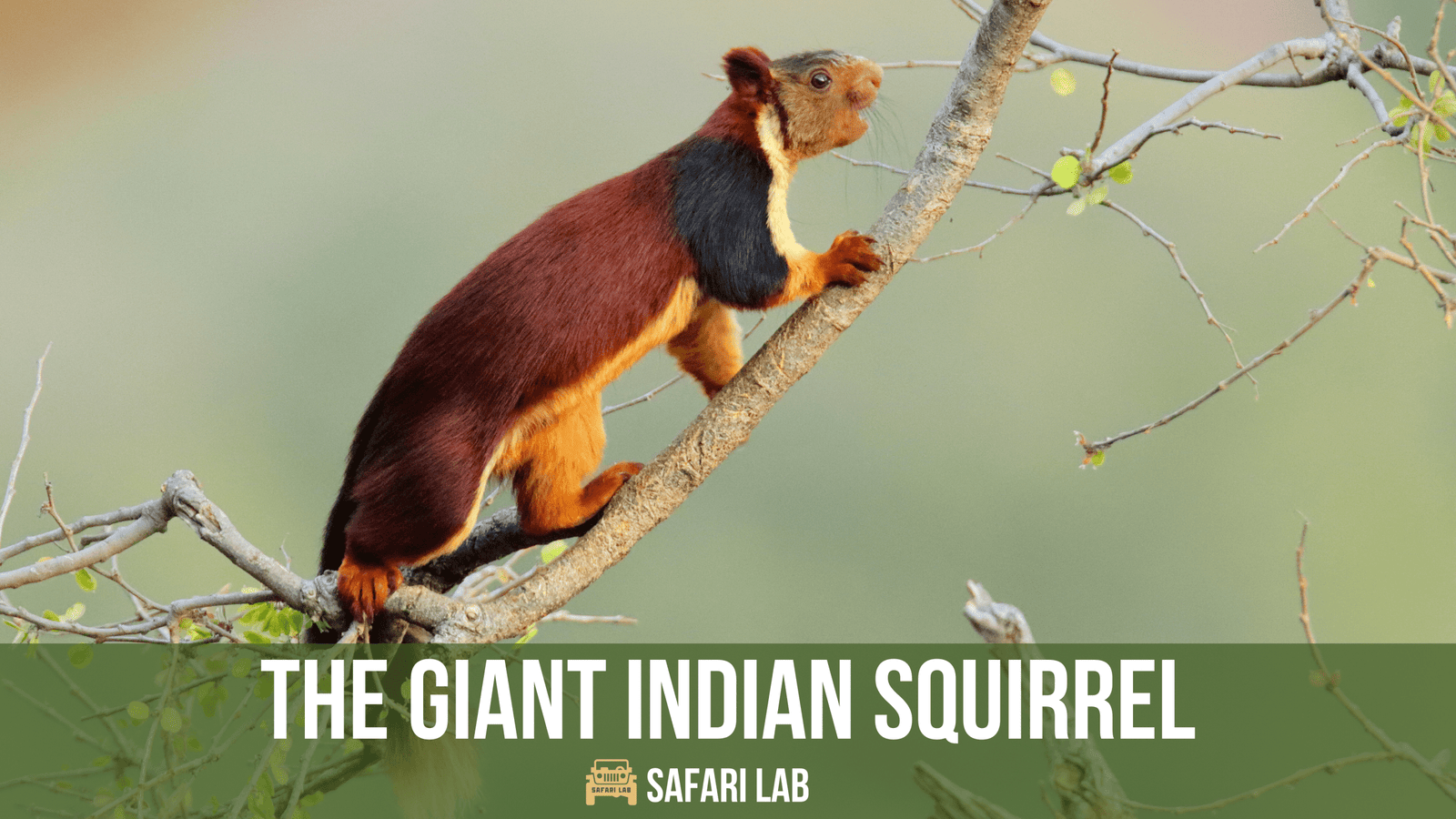
Meet the Indian giant squirrel, or Malabar giant squirrel (Ratufa indica). Imagine a coat painted in maroon, chestnut and cream, with shades that sometimes look almost purple. Add an extravagantly bushy tail, strong little paws and the ability to disappear through the treetops before you’ve quite worked out what you’re looking at.
Its spectacular coat may draw the eye, but its way of life is even more remarkable. Almost everything that matters to this squirrel unfolds high above the forest floor.
Its roads are branches. Its houses are woven from leaves.
It has neighbours to contend with, favourite places to eat and even food tucked away for leaner days. And if the branches between two trees disappear, part of its world may disappear with them.
Maharashtra calls it the shekru and has made it the state animal. Spend a little time getting to know the Indian giant squirrel, and you’ll understand why it deserves far more attention than its extraordinary colours.
How big is the Indian giant squirrel?
Compared with the familiar palm squirrels of gardens and city walls, the Indian giant squirrel belongs to an entirely different scale. Its body measures roughly 25–45 centimetres, while the long, luxuriant tail can bring a particularly large individual’s total length close to a metre. Weighing approximately 1.5–2 kilograms, it is among the most striking mammals of India’s forest canopy.
India is also home to the grizzled giant squirrel (Ratufa macroura) in parts of the south. Despite their similar common names, these are two distinct species.
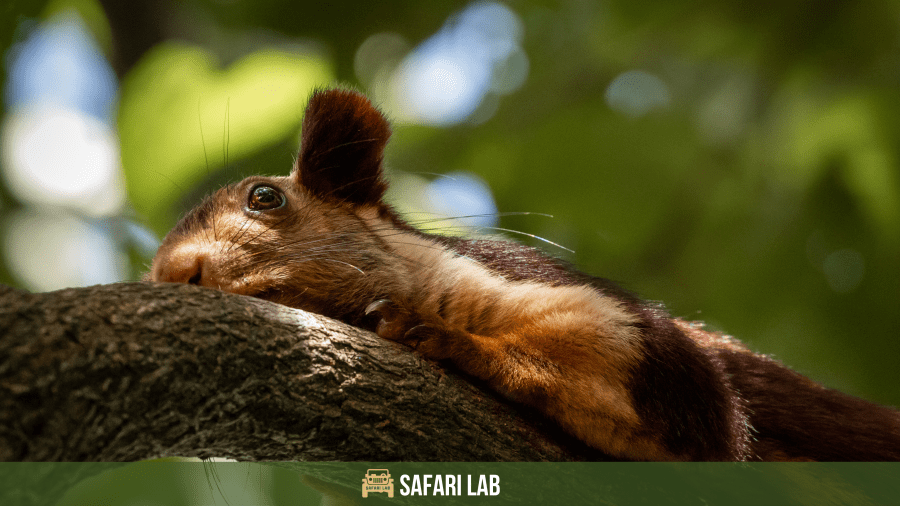
Its agility seems almost at odds with its size. Powerful claws grip the bark, the hind legs propel it towards the next branch, and the long tail helps steady its passage through the trees. Gaps that appear daunting from below are crossed with extraordinary confidence. No single jumping distance describes the species: each leap depends on the animal, the branches and the space between them.
Then, without warning, the movement ceases. The squirrel settles on a branch and begins to feed, holding its food between its forepaws. For a few minutes, it may remain in full view. At other times, a fleeting glimpse of that extraordinary tail is all the forest allows before the animal disappears among the leaves.
Why does the Indian giant squirrel look purple or rainbow-coloured?
At first glance, the colours seem almost improbable: maroon, chestnut, cream and, in certain light, a shade that appears purple. Photographs can look so vivid that a viewer might suspect digital manipulation. Yet these richly varied coats belong to the Indian giant squirrel. No two individuals need display exactly the same pattern.
I was scanning the canopy in Dandeli, watching for the familiar sweep of a great hornbill’s wings. There is something unmistakable about those birds in flight, and my eyes kept returning to the spaces between the treetops. But it was something quite different that held me there. Among the branches was an Indian giant squirrel, its coat an extraordinary tapestry of maroon, chestnut and cream. For a few minutes, the hornbills were forgotten. I could only watch, astonished that a creature so vividly coloured could belong so completely to the forest around it. Some of the photographs in this article were taken on that very trip.
When photographs of these squirrels spread widely online in 2019, some headlines suggested a newly discovered rainbow-coloured species. In fact, Ratufa indica was already familiar to scientists and to communities living near its forests. What was new was the attention it received.
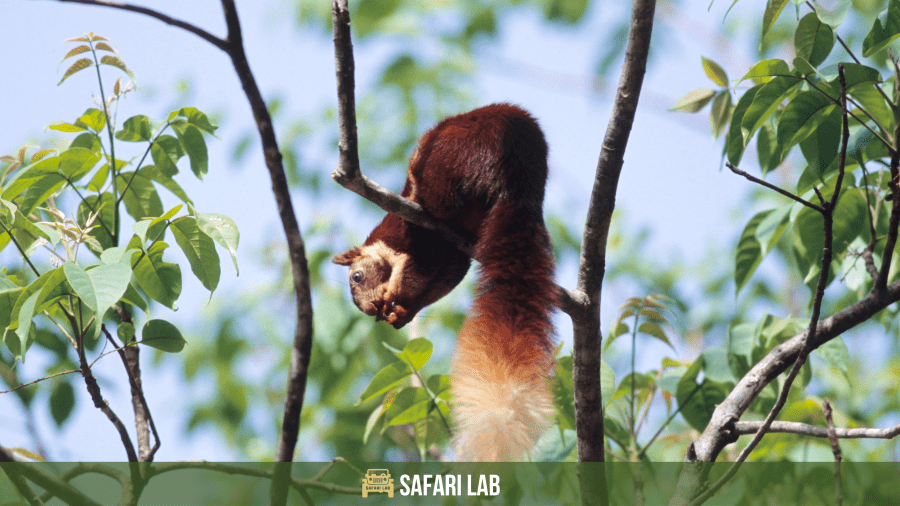
The more intriguing question lies beyond their beauty. Why should an animal exposed to predators in the canopy carry such conspicuous colours?
Against an open background, those colours appear conspicuous. Against reddish bark, deep shadow and the shifting patterns of light within a forest crown, their effect can be very different. The coat may help the animal blend into its surroundings, but the function of its many shades has not been conclusively established. The apparent purple remains an intriguing observation rather than a fully explained adaptation.
A coat that looks impossible in a photograph may make perfect sense when you see the forest around it.
An entire neighbourhood above the forest floor
For the Indian giant squirrel, the forest is experienced largely without touching the ground. It feeds, rests, travels and raises its young within the canopy. The occasional descent is an exception to a life shaped almost entirely by the trees.
But what appears to be continuous forest from the ground may conceal a landscape of formidable obstacles above it.
Consider a road passing through otherwise flourishing woodland. Tall trees remain on either side, their foliage giving the impression of an intact forest. Yet overhead, the crowns may no longer meet. For an animal accustomed to moving from branch to branch, that apparently modest gap can sever a familiar route between feeding sites and shelter.
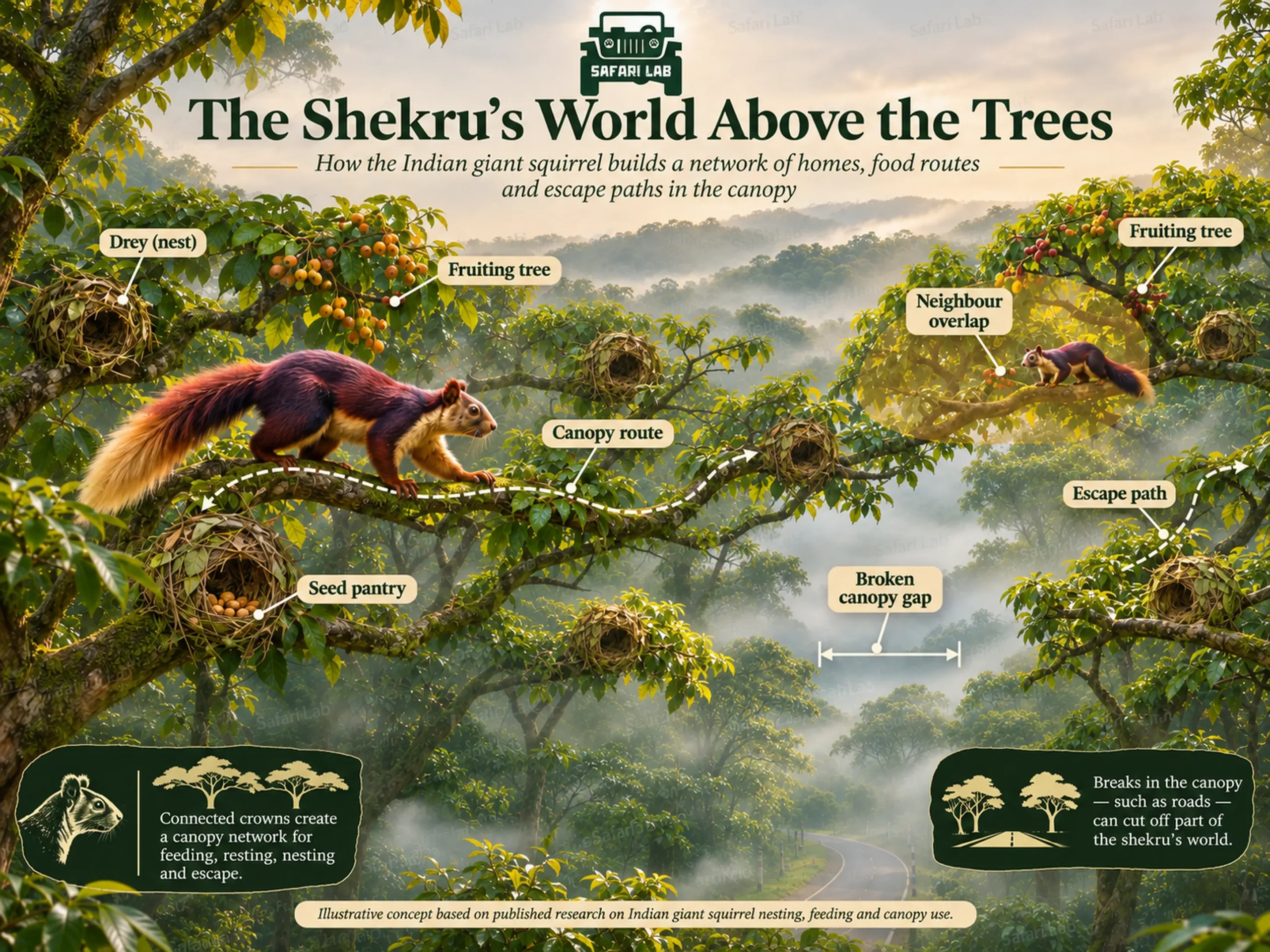
Ecologists call these links canopy connectivity. To the squirrel, they are passages between feeding sites, nests and places of refuge. A study in Mudumalai found that nesting trees tended to be taller and sturdier, with better connections to neighbouring crowns. The squirrels observed there occupied home ranges averaging just 1.3 hectares. That figure comes from a particular study, not a universal measure, but it reveals how much of the animal’s life can unfold within a seemingly small stretch of forest.
Within such a small territory, a single fruiting tree may become especially important. Its position, the branches leading to it and the presence of neighbouring squirrels all influence access to food. A forest crown is not merely a place to pass through; it can be a destination worth returning to, and sometimes defending.
Once you begin looking at the canopy this way, you can’t quite see a forest the same way again.
One squirrel, several nests
Look carefully into the fork of a mature tree, where two substantial branches meet. A rounded mass of leaves and twigs may be more than fallen debris caught in the canopy. It could be the carefully constructed nest of an Indian giant squirrel, known as a drey.
A single squirrel may maintain more than one such refuge. Some individuals have been observed with six to eight nests, occasionally using two or three within the same period. Each is assembled from twigs and interwoven leaves, with softer material inside and often an entrance to one side. Not every nest is occupied, and their individual functions are not all established.
The choice of tree is no less revealing than the architecture of the nest itself.
At Bhimashankar, in Maharashtra, researchers went looking for squirrel nests—and counted an astonishing 4,224 of them. Their study recorded nest trees belonging to 52 species. Mango and Olea dioica appeared especially often. But the real pattern was in the shape of the trees: the squirrels favoured trees that were tall, substantial and connected to the next crown.
There is a practical advantage to such a location. The researchers watched threatened squirrels retreat into neighbouring trees, using the same connections that give them access to food. Their nests contained layers of woven leaves, sometimes gathered from other trees. High above the forest floor, a small animal builds its shelter piece by piece, while ensuring that an escape route is close at hand.
That old tree you’ve walked past without a second glance? For this squirrel, it might be a bedroom, a lookout, a bridge and a refuge—all at once.
Some of those leafy homes are also food stores
Food storage is often associated with squirrels burying nuts beneath the soil. The Indian giant squirrel offers a different picture, one played out entirely above ground.
Some of these nests serve another purpose. High in the canopy, they can become stores for seeds gathered elsewhere in the forest.
In a remarkable study, Hema Somanathan, Subhash Mali and Renée Borges documented Indian giant squirrels storing seeds from six species of trees and climbers inside their treetop nests. More intriguingly, seeds from two of those plants were stored without being eaten fresh. Why should an animal preserve something it does not immediately consume?
Changes in the seeds over time may play a part, perhaps even chemical changes, but the evidence does not establish why they are stored. The distinction matters: the behaviour is documented; its precise advantage remains an open question.
Food kept in a nest also has a cost: it may attract another squirrel. The researchers observed that the risk of food theft could affect whether seeds were stored at all. Even in these secluded treetop refuges, a squirrel’s decisions are shaped by the presence of its neighbours.
The picture becomes considerably richer. Beyond its extraordinary appearance is an animal that stores food, responds to competition and makes use of a remarkably complex world suspended among the branches.
What does the Indian giant squirrel actually eat?
As the seasons change, so does the food available in the canopy. Fruit may give way to seeds, flowers, leaves, bark, leaf stalks or other tender plant tissue. The Indian giant squirrel responds to this changing supply, drawing on a wider range of plants than its colourful appearance might lead you to expect.
Consider the evidence from Mudumalai. Across more than 24,000 minutes of observation, researchers recorded giant squirrels feeding on parts of 25 plant species. Teak alone accounted for approximately 41% of observed feeding in that population. It is a striking reminder that the animal’s diet reflects the particular forest it inhabits; the figure cannot be applied to every population. The full Mudumalai study reveals the range of plants involved.
If you get a chance to watch one feed, don’t rush. Look at those front paws. It holds its food, turns it, works carefully through the parts it wants and leaves the rest. You begin to notice that eating isn’t just a pause between acrobatics; it’s a fascinating little performance in itself.
The squirrel’s relationship with forest regeneration is equally complex. It may disperse the seeds of some plants while consuming or simply dropping those of others. Feeding on fruit does not, by itself, make an animal an effective seed disperser.
With Myristica beddomei, for example, the squirrels have been observed eating the fleshy aril that surrounds the seed and dropping the seed, often beneath the parent tree. In other circumstances, seeds may be carried, consumed or stored. The ecological consequences depend upon what happens to each seed after the encounter.
Is the squirrel a disperser of seeds, or a predator of them? The question has no single answer.
It depends on the tree, the seed and what the squirrel does next. The same animal can play different ecological roles within the forest.
What happens when giant squirrels meet?
The Indian giant squirrel is generally solitary. A single animal moving through the canopy is a familiar sight; encounters between two can reveal far more about the relationships that shape their lives.
Solitary living, however, does not mean isolation. Home ranges may overlap, and a productive fruiting tree can draw more than one individual into the same crown. At such moments, feeding becomes part of a quieter contest over space and access to food.
These encounters are not always silent. Giant squirrels call when disturbed or in the presence of another individual, and a sound from the canopy may be your first indication that one is nearby. Yet the meaning of individual calls remains incompletely understood. Their vocal repertoire has not been documented well enough to assign a reliable interpretation to every sound.
Listen for the call, then watch the animal’s response. A pause against the trunk, a sudden change of direction or a swift retreat along a neighbouring branch may tell you as much as the sound itself.
How does the shekru raise its young?
Somewhere in those leafy nests, another little drama unfolds. A mother squirrel raises her young far above the ground, sheltered inside a woven home. Litters usually contain one or two youngsters, though three have occasionally been reported. Imagine the first time a tiny squirrel ventures from that shelter onto a branch. For an animal born into a world of dizzying heights, learning to move through the trees is everything.
Breeding has been observed at different times of year. Males may compete for females; the young remain protected in the nest before gradually venturing out. But it would be a mistake to turn those broad observations into an exact calendar that applies to every forest.
You will find websites offering very precise figures for how long a female is pregnant and when her young become independent. The trouble is that much of this species’ breeding life is still poorly documented. The Animal Diversity Web account reflects those gaps, and some figures repeated online actually belong to another species of giant squirrel. Better to keep the mystery than manufacture certainty.
We know a remarkable amount about this animal’s nests and food. About some of its most private moments, we still have much to discover.
Who hunts a squirrel that lives so high up?
Life above the forest floor offers refuge from some threats, but brings the squirrel into reach of others. Birds of prey hunt from the air, while snakes and climbing carnivores can approach through the trees. The dangers vary from one forest to another.
Watch a threatened squirrel and you may see it flatten against a trunk, freeze or suddenly bolt along a branch. And if that branch leads into another tree, there’s its escape. Imagine how different things become when that crossing no longer exists.
Once again, the connected canopy proves vital. Shelter matters, but so does the ability to flee from it into another tree.
Where can you see an Indian giant squirrel in India?
You need not venture into an inaccessible rainforest to encounter the Indian giant squirrel. It inhabits suitable forests across the Western Ghats, parts of the Eastern Ghats and the hills of central India. Its distribution, however, is not continuous across these regions. The presence of mature trees—and the connections between their crowns—matters more than a mountain range’s name on a map.
Bhimashankar, Maharashtra
If you’re in Maharashtra, Bhimashankar is a wonderful place to begin understanding the Indian giant squirrel. This is the animal’s home state, and the sanctuary’s old trees and connected crowns have helped make it one of the best-studied places for the species. Look beyond the obvious greenery and start noticing how many possible squirrel pathways run overhead.
The Western Ghats
Across Maharashtra, Goa, Karnataka, Kerala and Tamil Nadu, suitable Western Ghats forests support the Indian giant squirrel. Don’t expect each forest to look the same—or each squirrel to wear precisely the same colours. Wetter woodland and more seasonal forest each offer a slightly different stage.
Satpura and central Indian forests
The species is not confined to southern rainforests. It also inhabits suitable central Indian forests, where seasonal changes in foliage and food create a very different canopy environment. Its presence across these landscapes speaks to a wider ecological range than its rainforest reputation might suggest.
Parts of the Eastern Ghats
Parts of the Eastern Ghats are also home to the Indian giant squirrel. But don’t simply pick any sanctuary on the map and expect to meet one. Knowing which forest patches still hold suitable trees is far more useful than knowing the name of a mountain range.
To have a chance of seeing one, watch mature trees and fruiting branches, and listen for movement overhead. The canopy may appear still for long stretches. Then a flash of maroon crosses the leaves, an impossibly long tail follows, and the squirrel is gone into the next crown. Such sightings reward patience and an attentive eye.
The conservation surprise: nests in eucalyptus plantations
Perhaps the most unexpected finding comes from a landscape that, at first, seems an unlikely refuge: a plantation of exotic timber trees.
We usually imagine a wild squirrel choosing an old, native forest. And we’d generally worry about exotic timber plantations replacing that forest. But what if, in some places, the giant squirrel starts building its nest in the very plantation trees we think of as part of the problem?
In the Palani Hills, a study published in December 2025 documented 70 giant-squirrel nests in exotic timber plantations. Remarkably, 73% were recorded in eucalyptus trees. The nests were more often associated with areas closer to surviving rainforest and farther from agricultural disturbance. The finding complicates any simple division between natural forest and altered habitat.
This does not make a eucalyptus plantation ecologically equivalent to native rainforest. The diversity and ecological relationships of a natural forest cannot be replaced so easily. But mature plantation trees may provide nest sites and connections to nearby rainforest that some giant squirrels can use.
The discovery raises a difficult question for conservationists working to restore these altered landscapes.
Imagine a hillside where mature eucalyptus trees are being removed to make way for native forest. The long-term ecological goal is sound. But some of those trees may already hold active squirrel nests. A sapling cannot immediately replace a mature nest site or the branches linking one crown to another. Restoration therefore calls for careful sequencing, with the animals currently using that canopy taken into account.
The answer isn’t to leave exotic plantations untouched forever. It’s to restore native forest thoughtfully, with an eye on when replacement canopy will be ready and how squirrels can continue moving safely in the meantime.
Perhaps that’s the most unexpected thing this colourful squirrel teaches us: saving a forest can be as much about how we change it as about what we plant.
Is the Indian giant squirrel endangered?
The Indian giant squirrel is listed as Least Concern on the IUCN Red List. That status, however, deserves careful reading. The assessment also identifies a decreasing population trend, and its 2016 date means it should not be mistaken for a current census of the species across India.
Least Concern does not mean ‘nothing to worry about’. It means the species as a whole isn’t presently considered at high risk of extinction. A local population can still vanish if its old trees, feeding sites and aerial pathways disappear.
Picture that road through the forest again. The greenery may look reassuring. But roads, logging, land-use changes and the removal of mature trees can leave the canopy in pieces. From the ground, it can be easy to miss what the squirrel has lost.
For this canopy-dweller, saving trees isn’t merely about counting how many remain. It’s about preserving a living network of branches, food and shelter—the very thing that makes its world possible.
How to watch and photograph a giant squirrel
To find an Indian giant squirrel, begin by giving the forest time. Pause beneath a mature, spreading tree and follow the branches with your eyes. Listen for movement in the canopy. Often the animal remains almost perfectly still, until a maroon tail shifts among the leaves and betrays its presence.
With a camera, a little distance can make all the difference. From directly beneath a tree, the foliage may conceal the animal; a few steps back can reveal its tail, posture and behaviour. The quiet sight of a squirrel feeding may tell a richer story than a distant flash of colour.
Never clap, shake a branch or attempt to draw the animal into the open. Disturbing a squirrel changes its behaviour and deprives you of the chance to observe it naturally.
The colours will tempt you to make a portrait. But wait for something more. A squirrel carrying leaves to its nest. Turning a seed in its paws. Pausing to listen to another animal. Testing the gap before a leap. That’s when the photograph begins to tell a story.
The forest above us
The colours of the Indian giant squirrel are unforgettable. Yet they are only the beginning of what makes this animal remarkable.
Above the forest track lies an intricate world of woven nests, stored seeds, fruiting trees and encounters between neighbours. Its pathways are formed not from earth or stone, but from living branches whose connections sustain the life moving through them.
So the next time you’re in an Indian forest, by all means keep an eye on the track. A tiger may just walk out.
But every now and then, look up. There’s an entire forest waiting above your head.
Frequently asked questions
Is the Indian giant squirrel the same as the Malabar giant squirrel?
Yes. Both common names refer to Ratufa indica, called shekru in Maharashtra. It is different from the grizzled giant squirrel of southern India.
Are purple or rainbow squirrels real in India?
Yes, Indian giant squirrels can have dark maroon, reddish, cream and purple-looking coats. They are not a newly discovered rainbow species; the dramatic pictures that went viral showed a known animal.
How big is the Indian giant squirrel?
Its head and body are roughly 25–45 cm long, with a long bushy tail that may bring its overall length close to a metre. Adults commonly weigh around 1.5–2 kg.
What does an Indian giant squirrel eat?
Its diet includes fruit, seeds, leaves, flowers, bark and other plant material. The balance changes with season and the trees available. It can also store seeds inside nests high in the canopy.
How many nests does an Indian giant squirrel build?
Research describes individual squirrels maintaining around six to eight nests, with several used during the same period. The nests, or dreys, are made from twigs and leaves high in trees.
Does the Indian giant squirrel come down to the ground?
It is strongly arboreal and spends most of its life in the trees. It generally relies on connected branches rather than routine ground travel.
Where is the Indian giant squirrel found?
In suitable parts of the Western Ghats, Eastern Ghats and central Indian hill forests. Bhimashankar in Maharashtra is especially well known for the species.
Is the Indian giant squirrel endangered?
It is globally classified as Least Concern, but its assessed population trend is decreasing. Fragmentation and loss of mature, connected forest are continuing concerns.