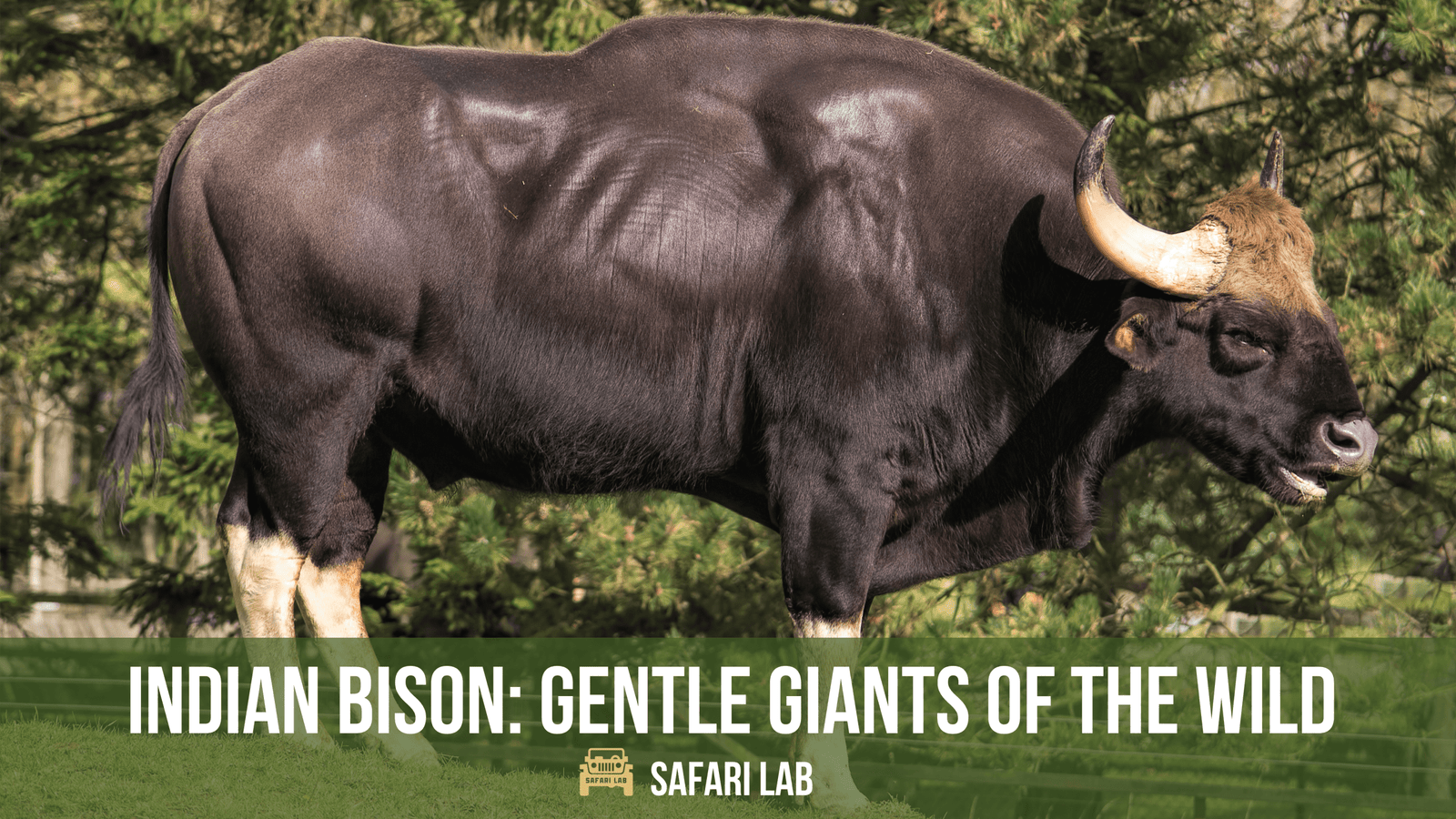
At the edge of a forest clearing, the undergrowth begins to move. First comes the sound of vegetation being torn from the ground. Then a great dark shoulder emerges between the trees, followed by a heavy neck, curved horns and four pale legs that seem almost too delicate for the weight they carry.
This is the gaur (Bos gaurus), commonly called the Indian bison. Yet despite that familiar name, it is not a bison at all. It is wild cattle: the largest living species of wild bovine, and one of the most formidable herbivores in the forests of southern and Southeast Asia.
A mature bull does not need to charge or even lift its head to command attention. Its mass, the high ridge of muscle over its shoulders, and the almost polished darkness of its coat are striking enough. But the animal’s real story lies beyond its size—in its changing relationship with the forest, its herd, its predators and the fragmented landscapes through which it must move.
The gaur is a creature of immense strength, yet its future depends on something far more fragile: the continuity of the forest around it.
The animal behind the name
There is a reason the name Indian bison has endured. The great shoulder hump, dark coat and formidable horns invite comparisons with the bison of North America. But the resemblance is deceptive. The gaur belongs to the cattle genus Bos; American and European bison belong to a different genus, Bison. Its scientific name is Bos gaurus, and among living wild cattle none is larger.
A mature bull can stand around 2.2 metres at the shoulder. The body is deep and heavy, with the shoulder ridge rising sharply behind the neck. Its horns curve out from the head and turn upwards, while the lower legs are often a striking pale colour. A young animal’s coat is warmer and lighter; the deep brown, nearly black colour of a fully grown bull develops with age. Females generally retain a lighter brown coat.
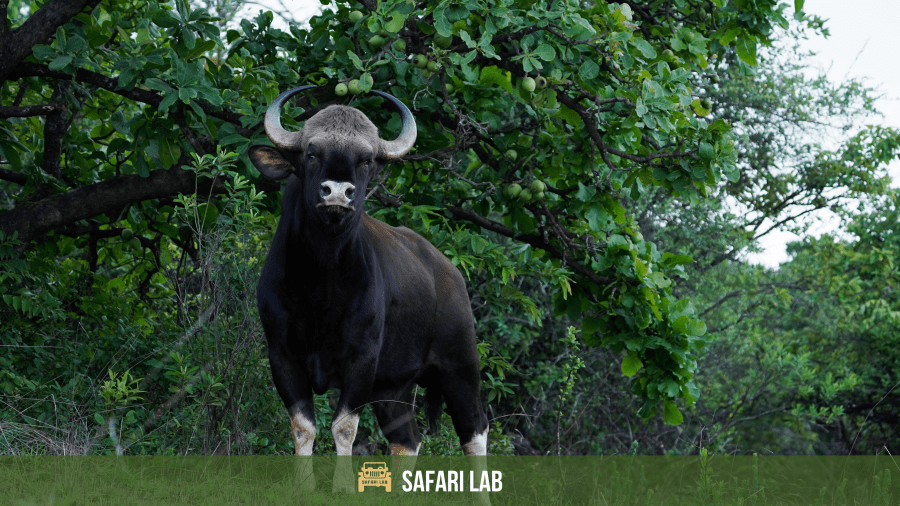
These details are easy to list, but they are worth looking for in the field. The ridge makes the front of the body appear almost impossibly tall; the pale legs show clearly even in broken forest light. A bull turning its head can reveal the breadth of the forehead and the extraordinary span of the horns. The IUCN SSC Asian Wild Cattle Specialist Group provides a useful scientific account of this species and its shrinking range.
The changing company of a gaur herd
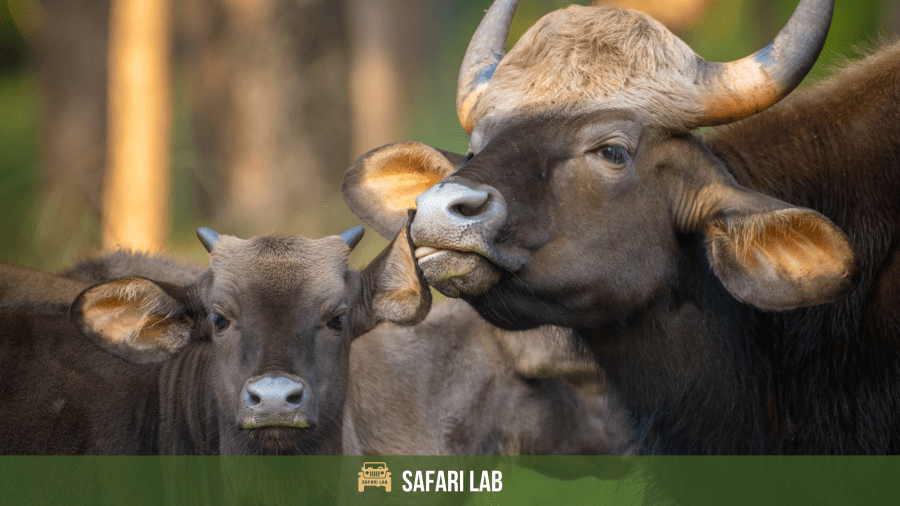
A group of gaur at a forest clearing is rarely still for long. One animal tears at the grass while another raises its head. A calf shifts closer to its mother. A few steps taken by one cow may draw the rest forward, and gradually the entire herd moves towards the next patch of food. The great bodies seem to pass almost silently into the trees.
Most mixed groups are made up of females, calves and young animals, sometimes accompanied by an adult bull. But bulls do not necessarily remain with the same herd throughout the year. In research on gaur reintroduced to Bandhavgarh, two radio-collared males were frequently found alone, then joined family groups for periods of roughly ten to fifteen days. The observed groups varied from a single animal to nineteen.
That is an intriguing detail to remember when a lone bull appears beside a track. It may look detached from every other living thing, but it belongs to a wider, shifting society. A herd is not a fixed procession with one animal permanently in charge. Its membership changes; so does the distance its animals keep from one another.
For calves, staying near the adults matters. Their smaller bodies and lighter coats make them quite unlike the massive bulls they may eventually become. There is tenderness in the ordinary business of a young animal keeping pace with its mother, though the surrounding forest remains a place of very real danger.
Following the food through a changing forest
Imagine the same clearing at the end of the dry season and again after weeks of monsoon rain. The ground is different, the grasses have changed, and foliage that was once beyond reach may now be tender and plentiful. A gaur does not eat its way through the year from a fixed menu. It moves between grasses and the leaves, shoots and other parts of woody plants, taking advantage of what the season offers.
Researchers monitoring the animals brought back to Bandhavgarh found an unexpected range in that diet. They recorded 22 tree species being eaten in summer, compared with 11 during the monsoon and nine in winter. The same study found greater use of grasslands in summer, while bamboo forests received more use during the monsoon and winter. These were patterns observed in that population, not a universal timetable for every gaur across Asia.
What makes those numbers remarkable is the picture they reveal. The enormous animal that appears to be doing nothing more complicated than grazing is making its way through a landscape of seasonal opportunities. When food changes, so can its route through the forest. The 2013 field study also followed how the reintroduced animals used different parts of Bandhavgarh across the year.
Water becomes particularly important during dry periods. Around waterholes, forest openings and grassy edges, several needs converge: feeding, drinking, shelter and access to the next patch of suitable habitat. For that reason, the loss of a route between two useful areas can matter even when the forest on either side still looks green.
Where the great herds still move
The gaur has no single Indian landscape that can claim it. In the Western Ghats, it moves through a rich mixture of moist forests, wooded slopes and open feeding areas. Farther north, populations survive in the varied forests of central and eastern India. Beyond India, the species occurs in parts of South and Southeast Asia, although its distribution has contracted and become fragmented.
In the connected forest landscapes around Bandipur and Nagarahole, a group may emerge onto a grassy opening or linger at the edge of woodland. Central India’s Kanha offers a different setting, with large expanses of forest and meadow. The animal is recognisably the same, but the landscape around it shapes where and when it is seen.
A sighting is never guaranteed by a name on a park map. What matters is where the herd is feeding, whether the season has drawn it towards water, and how much of its day is spent under the cover of trees. A little time watching a herd from a respectful distance can reveal more than approaching for a closer photograph.
The tiger and the forest’s largest wild cattle
A tiger is capable of bringing down a gaur. That single fact can seem improbable when a full-grown bull is standing in front of you. The animal has a formidable build, powerful legs and horns that can make close contact dangerous. But forests are not arranged into simple contests between the strongest animals.
Age, condition, surprise and the ground underfoot can all change an encounter. A smaller or vulnerable gaur is not the same challenge as a mature bull in good condition. Tigers are ambush hunters, and the presence of dense cover can influence whether an attack is even possible. The fact that gaur feature in the diet of tigers does not mean every meeting between the two ends in violence.
There is another reason this relationship matters. A landscape that supports large herbivores helps sustain the predators that depend on wild prey. In Bandhavgarh, restoring gaur was also part of restoring the ecological life of a forest from which the species had disappeared. It is the quieter, everyday presence of prey populations—not only the rare drama of a hunt—that makes a tiger forest what it is.
Bandhavgarh: the long road back
For years, Bandhavgarh’s forests held no gaur. The species had disappeared locally by 1998, even though the reserve retained habitat capable of supporting it. The loss is thought to have involved pressures including the severing of routes between forests. The absence of such an enormous animal is difficult to imagine, yet a generation of visitors could pass through the reserve without seeing one.
Then came an ambitious effort to bring them back. In January 2011, nineteen gaur—fourteen females and five males—were moved from Kanha to Bandhavgarh. A second translocation followed in March 2012, adding thirty-one more—twenty-two females and nine males. Fifty animals were moved across the two phases. The work is documented in research from the Wildlife Institute of India.
Moving animals was only the beginning. In their unfamiliar surroundings, the gaur explored. Researchers tracked radio-collared individuals, recording where they travelled, where they fed and how they used the habitat as seasons changed. During the initial summer of the study, the reintroduced animals ranged across an estimated 290 square kilometres; their area of use subsequently contracted as they settled into more familiar routes. The published study captures those first months of adjustment.
It is easy to picture the release as the defining moment: a gate opening and a large animal stepping into the trees. But the real measure of success unfolds long afterwards. Does a cow find the food she needs? Does a calf survive? Will a bull move between herds? And can the population remain established through years of changing weather, predation and pressure beyond the reserve?
Those are the questions that make Bandhavgarh’s gaur story so absorbing. They transform a conservation project from a single event into a continuing chapter in the life of a forest.
The danger beyond the forest boundary
A gaur is enormous, but it cannot push its way through every obstacle in a changing landscape. A road, a settlement or a plantation may interrupt a route that once connected grazing areas, water and shelter. Animals moving beyond protected forests can come into conflict with people; they may also encounter domestic cattle and the diseases livestock can carry.
The species is assessed globally as Vulnerable on the IUCN Red List. Habitat loss, hunting, disease and the separation of populations have all contributed to pressure across its range. The picture is not identical everywhere: some Indian reserves still support conspicuous gaur populations, while populations elsewhere are far less secure.
Studies from Chitwan in Nepal and Tamil Nadu explore different aspects of habitat use and encounters between gaur and people. Such work matters because the animal’s life cannot be contained within an administrative line on a map. The routes it uses and the risks it meets are often shared with communities living beside the forest.
Protection therefore means more than counting animals inside a national park. Healthy habitat, access to water, connections between forests and practical measures to reduce conflict all influence whether herds can persist.
Watching gaur without disturbing them
If a herd appears on a safari, allow the scene to unfold. A calf may be partly hidden among the adults. An animal feeding steadily may lift its head and look towards a distant sound. The herd may cross the clearing at its own pace, leaving the grass to settle after it passes. There is no need to push closer to find a story worth watching.
For photography, the surroundings can be as revealing as the animal. A great bull beside a tree gives the eye a sense of scale. A group spread across a meadow shows something of its social life. The curve of the horns and the pale lower legs are distinctive, but so is the space the herd needs around it.
Keep a respectful distance. Never approach on foot, block the animals’ path, or try to make a resting gaur stand for a photograph. An animal that seems absorbed in feeding can still react powerfully if threatened, particularly when calves are nearby.
When the forest falls quiet again
Eventually the herd moves on. A last dark back passes between the trunks, a pair of pale legs vanishes into shadow, and the clearing looks much as it did before. Yet the animals are still moving through the forest—towards food, water, other herds and the places the changing season draws them.
In Bandhavgarh, that ordinary movement had once ceased entirely. The return of gaur is a reminder of how much can disappear from a forest without a dramatic final moment, and how much patient work it can take to make such a presence possible again.
Frequently asked questions
Is the Indian bison actually a bison?
No. “Indian bison” is a common name for the gaur (Bos gaurus), a species of wild cattle. It is different from the American and European bison.
Is the gaur the largest wild cattle species?
Yes. The gaur is generally recognised as the world’s largest living species of wild cattle. Very large bulls can stand around 2.2 metres at the shoulder.
Are gaur dangerous to people?
They can be, particularly if threatened, surprised at close range or approached near calves. They should be observed from a respectful distance and never provoked.
Do tigers hunt gaur?
Yes. Tigers can prey on gaur, but the size and strength of an adult animal make such encounters risky. Not every tiger–gaur encounter ends in an attack.
What do gaur eat?
They graze and browse, feeding on grasses, leaves, shoots and other vegetation. Their diet changes with season and local plant availability.
Where can I see gaur in India?
They occur in suitable forests of the Western Ghats and central and eastern India. Reserves including Bandipur, Nagarahole, Kanha and Bandhavgarh are among the landscapes where they may be observed.
Why were gaur reintroduced to Bandhavgarh?
The species had disappeared locally. A conservation programme beginning in 2011 translocated gaur from Kanha to restore a population and study its adaptation to the reserve.
Are Indian gaur endangered?
The species is classified globally as Vulnerable, rather than Endangered, on the IUCN Red List. Habitat loss, hunting, disease and population fragmentation are continuing threats.