The Gypsy has barely entered the zone.
Dust still hangs behind the tyres. The driver slows near a bend, and the guide leans forward without saying much. There are no alarm calls. No tiger on the road. Nothing obvious at all.
Then he asks the driver to stop.
For the guest, this is the first test.
Why here?
Why now?
A few metres ahead, in the powdery soil, a pugmark crosses the road. Not dramatic. Not fresh enough to mean the tiger is close. But the toes are clean, the pad is sharp, and the direction matters.
The guide looks up.
Somewhere deeper in the forest, a sambar calls once.
Then silence.
This is the part of safari that photographs rarely explain.
You are not yet watching wildlife.
You are watching someone interpret a landscape.
And without realising it, you have already begun trusting them.
A Guide Is Asked to Read a Forest That Refuses to Explain Itself
The forest rarely gives anyone a complete sentence.
It gives fragments. A pugmark at one junction. A scrape beside a tree. Langurs looking down instead of feeding. Chital standing unusually still. A peacock calling where it had been silent ten minutes earlier.
None of these signs means very much alone. A pugmark proves that a tiger passed through; it does not tell you that the tiger is waiting around the next bend. An alarm call may point towards a predator, but it may also stop as abruptly as it began.
The guide’s job is not simply to notice these things. It is to decide which details are noise and which ones deserve attention.
Fresh tracks heading towards a nullah may be useful. The same tracks after several vehicles have driven over them may be old information. A single sambar call can be interesting. Repeated calls moving steadily through the forest begin to tell a different story.
This is the first transformation a good guide brings to a safari.
A guest may see a road through teak and bamboo. The guide sees where an animal has crossed it, where the ground changes, where visibility disappears, and where waiting may make more sense than driving.
The forest has not become easier to read.
Someone beside you has simply spent longer learning its language.
Trust Begins When the Guide Makes a Decision You Do Not Understand
A Gypsy comes quickly from the opposite direction. Someone calls out that there is a tiger near a waterhole, and another vehicle immediately turns to follow.
Your driver looks at the guide.
The guide stays where he is.
To someone on a first safari, that decision can feel absurd. There is apparently a tiger somewhere else. Why are we sitting here?
Then a sambar calls again from behind you.
Now the decision feels different.
This is where trust becomes one of the least discussed parts of a safari. A guest cannot independently judge every choice being made. They do not know how old the information from the other vehicle is, whether that animal is moving away, whether the road ahead is already congested, or whether the signs in front of them are actually more promising.
A good guide explains enough to make the reasoning understandable without turning every decision into a lecture.
Over several drives, something begins to change. You stop assuming that movement always means progress. You understand that staying still can also be a decision, and that waiting is sometimes an act of confidence rather than indecision.
That trust matters because much of safari happens before anything appears.
The Guide and Driver Are Reading the Same Forest From Different Seats
The relationship between guide and driver is one of the least visible parts of an Indian safari.
A driver who has spent years on the same roads develops an extraordinary practical memory of the landscape. They know which tracks become difficult after rain, where a Gypsy can turn quickly, which bend suddenly opens into good visibility, and how long it will take to reach another part of the zone.
They also notice wildlife.
A driver may remember where a tigress crossed on the previous afternoon, where wild dogs were seen at dawn or where a leopard has repeatedly used one stretch of road.
The guide is adding another layer: tracks, calls, behaviour, habitat, current information and an interpretation of how those clues fit together.
The best safari does not happen when one person tries to prove they know more than the other. It happens when the two streams of knowledge meet.
Sometimes the exchange is barely noticeable. A few words. A glance towards a junction. The driver slows. The guide listens. The vehicle turns.
No performance is required.
When a guide and driver have worked together long enough, a surprising amount can be communicated without the guests even knowing a conversation has taken place.
Some Days the Forest Simply Goes Quiet
There are mornings when the forest seems to be helping.
Fresh pugmarks appear on a road. Sambar call repeatedly. Langurs are restless. Another vehicle has already seen a tiger moving in your direction. Even before anything appears, the air inside the Gypsy feels different.
And then there are mornings when the forest seems to fold in on itself.
No alarm calls. No fresh tracks that lead anywhere useful. The tiger may have fed during the night and be sleeping somewhere no road reaches. A leopard may stay inside cover. Dholes may have crossed long before the gate opened. Even the animals you normally take for granted can seem strangely absent.
These are difficult mornings for guests.
They can be even harder for guides.
A family may have travelled across the country for two drives. Someone may have waited years to see a tiger. A photographer may have one morning left before flying home.
All of that expectation sits inside the vehicle.
None of it changes what the forest is doing.
Yet the guide often carries the pressure anyway.
When the Guide Is Expected to Produce a Sighting
It is easy to forget how strange an expectation this is.
We enter a wild landscape precisely because the animals are free to decide where they go, and then we quietly expect the person sitting beside us to produce one on demand.
On a quiet morning, the questions begin innocently.
Where is the tiger?
Wasn’t one seen here yesterday?
Can you call another guide?
Shouldn’t we go where those vehicles are going?
Most guests do not mean anything unreasonable by it. They have invested time, money and emotion in being there. Wanting to see the animal they travelled for is completely understandable.
But repeated often enough, that expectation can shape behaviour.
If guides are judged only by sightings, there is an incentive to chase every report. To drive faster. To abandon a productive patch because another vehicle has radioed or shouted about a tiger elsewhere. To ignore birds, trees, tracks and behaviour because none of them will satisfy the person asking, “But where is the tiger?”
And some days there simply is no answer.
The tiger may be fifty metres from the road and completely invisible.
A good guide still searches. They still use every clue available to them.
But they also have to accept something that safari guests sometimes struggle to accept:
the forest is allowed to have a quiet day.
A Good Guide Is Not a Tiger Finder
If we judged guides entirely by whether a tiger appeared, luck would become indistinguishable from skill.
A guide can make thoughtful decisions for four hours and return without seeing a big cat. Another can enter the park, take the ordinary route to a waterhole and find a tiger lying beside the road ten minutes later.
The second vehicle had the better sighting.
It did not necessarily have the better guiding.
A guide’s ability becomes clearer in everything around the sighting: how carefully they read signs, how they work with the driver, how honestly they handle uncertainty and whether they remain engaged when nothing spectacular is happening.
Wildlife does not reward competence fairly.
That is partly why safari remains interesting.
Sometimes the Best Guide Is the One Who Does Not Chase
News travels quickly inside a tiger reserve.
One vehicle finds a tiger and, within minutes, other Gypsies begin moving towards the area. Dust lifts above the road. Engines become louder. The quiet part of the forest suddenly has a destination.
Sometimes following makes complete sense. If the information is fresh and the animal is moving through an accessible part of the zone, there may be a genuine opportunity.
But not every report deserves a chase.
The animal may already have disappeared. The road may be filling with vehicles. Fresh tracks in front of you may belong to another tiger moving in the opposite direction.
This is where a guide needs both judgement and confidence.
The difficult part is that everybody else appears to be going somewhere.
Remaining still can feel like being left behind.
And sometimes the guide will be wrong. The tiger everyone chased may remain beside the road while the forest around you stays silent.
Fieldcraft is not prophecy.
What matters is whether the decision had a reason.
A Quiet Safari Is Where You Discover What Kind of Guide You Have
When a tiger walks down the road, the forest does most of the work.
Everyone is alert. Cameras are raised. Nobody needs convincing that the safari has become exciting.
A quiet drive is a different test.
Now the guide has to remain interested when the obvious prize is absent.
A sloth bear may have torn into a termite mound during the night. Dhole tracks may cross the dust. A Changeable Hawk-Eagle may be watching from a dead branch. Chital may suddenly stop feeding and stare towards a patch of grass.
None of these needs to be turned into artificial drama.
That is not the point.
A good guide expands what the guest notices without pretending that every leaf movement is significant.
The forest does not owe us a tiger.
But it rarely gives us nothing.
There is an enormous difference between a forest that is quiet and a forest that is empty.
A good guide helps you learn it.
The Best Guides Know When to Stop Talking
Knowledge can transform a safari.
Too much knowledge delivered at the wrong moment can flatten one.
There are times when the guide has already said enough. The engine switches off, and the ticking of cooling metal slowly disappears beneath the sounds of the forest. A drongo calls. Wind moves through dry leaves. Somewhere farther away, a sambar calls once.
Everybody listens.
A confident guide is comfortable with that silence.
They do not need to demonstrate expertise every minute. They understand that part of their job is to make the forest more intelligible, not to compete with it.
Sometimes the best interpretation is one word.
Listen.
For Many Guides, the Forest Is Home
There is another dimension to guiding in Indian reserves that is easily missed by someone arriving from a city for a few days.
Many guides come from villages around the protected area. In some landscapes, they belong to tribal or forest-edge communities whose families have lived beside these forests for generations.
They may have known parts of the landscape long before they sat in a tourist Gypsy.
A stream is not merely a blue line on a map. They have watched it shrink through summer and return with the monsoon. They know which road turns to mud first, where grass grows highest after the rains, where cattle once moved and how the forest itself has changed over the years.
Some knowledge can be taught during guide training.
Other knowledge accumulates almost accidentally through a lifetime of looking.
That does not mean every local guide is automatically a great guide. Deep familiarity with a forest does not necessarily bring good communication, curiosity or ethical judgement.
But when those things come together, the result is difficult to reproduce.
The guide is not simply visiting the landscape for work.
Part of their own history is embedded in it.
Local Knowledge Is a Kind of Memory
A guide who has spent years in one reserve carries an enormous map that exists nowhere on paper.
A nullah that holds water slightly longer than expected. A road used repeatedly by a tigress. A tree that has been scent-marked by several males. A patch where wild dogs tend to rest after a hunt.
The value of those memories is not that the same thing will happen again today.
It may not.
That is what separates experience from superstition.
A good guide uses memory to form possibilities without turning those possibilities into promises. They know that animals repeat patterns, and they know equally well that animals break them.
Experience tells them where to look.
The forest retains the right to disagree.
What Vinod Has Taught Us in Corbett
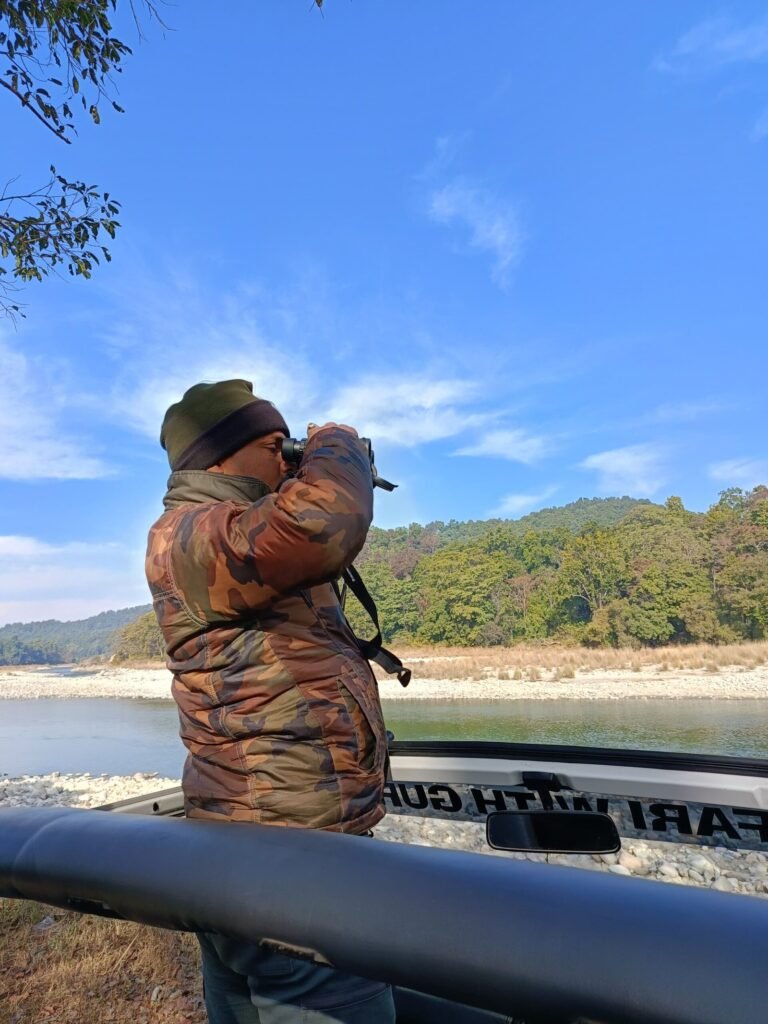
For us, this is not an abstract idea. In Corbett, we have travelled since 2008 with Vinod, whose fieldcraft has shaped some of our most unforgettable experiences in the reserve. Many of those sightings came not through speed or noise, but through patience, skill and anticipation — the ability to read the forest before it explains itself. Over the years, that has led us to extraordinary moments: newborn tiger cubs, a tigress hunting, and other sightings that felt genuinely exclusive not because they were chased, but because they were understood before they unfolded.
“Can We Go a Little Closer?”
A tiger is lying beside the road.
It is already close enough to watch comfortably, but another few metres might clear the branch in front of its face. The photographer in the back seat sees the frame immediately.
Can we go closer?
It sounds like a small request.
Sometimes it is.
Sometimes the correct answer is no.
Guides face another kind of pressure at sightings: the pressure to maximise the experience even when doing so begins to affect the animal.
A vehicle may be asked to creep forward again. To follow a tiger as it walks. To position itself ahead of an animal’s route. To remain when the animal is obviously trying to move through a crowded section of road.
The guest sees a photograph becoming possible.
The guide has to see the animal as well.
Sometimes Good Guiding Means Disappointing the Guest
A better angle does not automatically justify moving the vehicle.
A closer photograph is not automatically a better wildlife encounter.
There are moments when the most responsible decision a guide can make is to say no.
That can be uncomfortable.
The person asking may be the guest whose experience the guide is responsible for. They may have travelled specifically for photography. They may see another Gypsy move closer and wonder why theirs will not.
But the easiest way to please a guest in the next thirty seconds is not always the right way to conduct a safari.
Good guiding sometimes means protecting the animal from our enthusiasm.
A tiger needs room to cross.
An elephant needs space to choose its direction.
A leopard should not have its escape route closed because six vehicles want the same photograph.
A guide who understands that may occasionally give you a slightly worse picture.
They may also give the animal a much better encounter with us.
This Is Why We Prefer Working With the Same Guides
At Safari Lab, we have worked with many of the same guides for years, and wherever the park system permits it, these are the people we ask to accompany our guests.
Not because they can guarantee sightings.
They cannot.
What years of working together allow us to understand is something much more useful: how a guide behaves when there is no sighting.
We know who remains curious after three quiet hours. Who works well with drivers rather than trying to dominate the vehicle. Who will say they do not know rather than invent an answer. Who treats a bird, a wild dog or an interesting piece of behaviour as worth stopping for even when everyone entered the gate thinking about tigers.
We also know how they behave when the forest suddenly becomes generous.
Whether they crowd.
Whether they push closer.
Whether they respect another vehicle’s position.
Whether the excitement of a sighting changes the standards they follow when nothing is happening.
Those things matter to us far more than which guide happened to see the most tigers last week.
Our guest may be meeting that person for the first time.
We are not.
Part of the trust inside the Gypsy has therefore been built long before the guest climbs into it.
A Good Guide Reads the Guest Too
The forest is not the only thing being interpreted inside the vehicle.
A first-time visitor may want to know why every alarm call matters. An experienced wildlife traveller may prefer much less commentary. A photographer is thinking about light, direction and background, while a child may be completely fascinated by a mongoose that every adult in the vehicle has ignored.
A good guide notices this.
They do not deliver exactly the same safari to every passenger.
They know when someone wants information, when someone needs reassurance and when everybody would rather simply watch.
This is a quieter skill than identifying a bird from its call or recognising a tiger from its stripes, but it can shape an entire drive.
The best guides are reading two landscapes at once.
The forest outside the Gypsy.
And the people inside it.
For Photographers, Five Metres Can Matter
Photography introduces another layer of judgement.
A tiger emerging from bamboo may turn left, cross the road or disappear again almost immediately. Light may be falling from one side. A vehicle parked five metres farther back may have a cleaner view than the one directly beside the animal.
Good guides and drivers learn to anticipate these moments.
But anticipation is not the same as control.
The vehicle can be positioned thoughtfully. Space can be left for the animal to move. A likely direction can be considered.
The animal still decides whether there will be a photograph.
That boundary is important.
Sometimes five metres transforms an image.
Sometimes five metres is precisely the distance you should not move.
A Good Guide Is Comfortable Saying “I Don’t Know”
Forests invite certainty.
This tiger always comes this way.
That alarm call definitely means leopard.
He will cross here.
Sometimes the prediction is right.
And sometimes the tiger turns around, disappears into bamboo and does something nobody in the vehicle expected.
A good guide understands the difference between evidence and certainty.
“There are fresh signs here, so waiting makes sense” is very different from “the tiger will come.”
That distinction builds trust rather than weakening it.
We would rather work with a guide who says “I don’t know” when the forest has not given enough information than one who confidently invents an answer because they think the guest expects certainty.
Wild animals should retain the ability to surprise the people who know them best.
In fact, that may be one of the signs that those people are still paying attention.
What We Value in a Guide
Knowledge matters. Experience matters too.
But neither is enough on its own.
We value curiosity, judgement, patience, humility and restraint. We value guides who work with drivers rather than above them, who understand more than individual tiger names and who remain interested even when the forest has been quiet for hours.
We value someone who can explain without performing, who recognises uncertainty and who understands that a successful safari cannot be measured solely by the largest animal seen.
And perhaps most importantly, we pay attention to what happens when the guest wants something the guide should not give them.
Move closer.
Drive faster.
Follow the tiger.
Block the road.
A guide’s response in those moments tells you a great deal.
The Forest Is the Same. You Are Not.
At the beginning of the drive, a first-time guest may see a road, trees and deer.
Several hours later, the same road has acquired another layer.
A scrape carries meaning. A langur staring in one direction becomes difficult to ignore. A distant sambar call changes the mood in the vehicle. A pugmark in the dust is no longer simply a footprint, but evidence of another journey that crossed yours before you arrived.
Nothing in the reserve has become more dramatic.
The guide has not put more animals into the forest.
They have simply changed how much of it you are able to notice.
And sometimes, after all that listening and looking, the gates close without the tiger ever appearing.
The forest has had a quiet day.
A good guide cannot change that.
But they can make sure that quiet never feels quite the same as empty.