May 2008. Somewhere on the outskirts of Chandrapur, I was beginning to seriously question my choice of friends.
A photographer friend had persuaded me to join him on a trip to Tadoba, a forest I knew very little about at the time. He had been rather enthusiastic about the whole thing, promising an experience that would stay with me for years. What he had conveniently forgotten to mention was just how unforgiving a Central Indian summer could be.
We arrived at a solitary resort near Moharli Gate shortly before noon. The thermometer was already nudging 42°C. There was little sign of activity around us, and the afternoon seemed to stretch endlessly beneath a blazing sun. Having never experienced this part of India in peak summer, I was entirely unprepared for the heat.
By the time our afternoon safari began, the temperature had climbed to around 44°C. The hot, dry air was relentless. Seven minutes into the forest, I had already concluded that this was a spectacularly bad idea. I was just about to share that opinion with my friend when our Gypsy came to an abrupt halt.
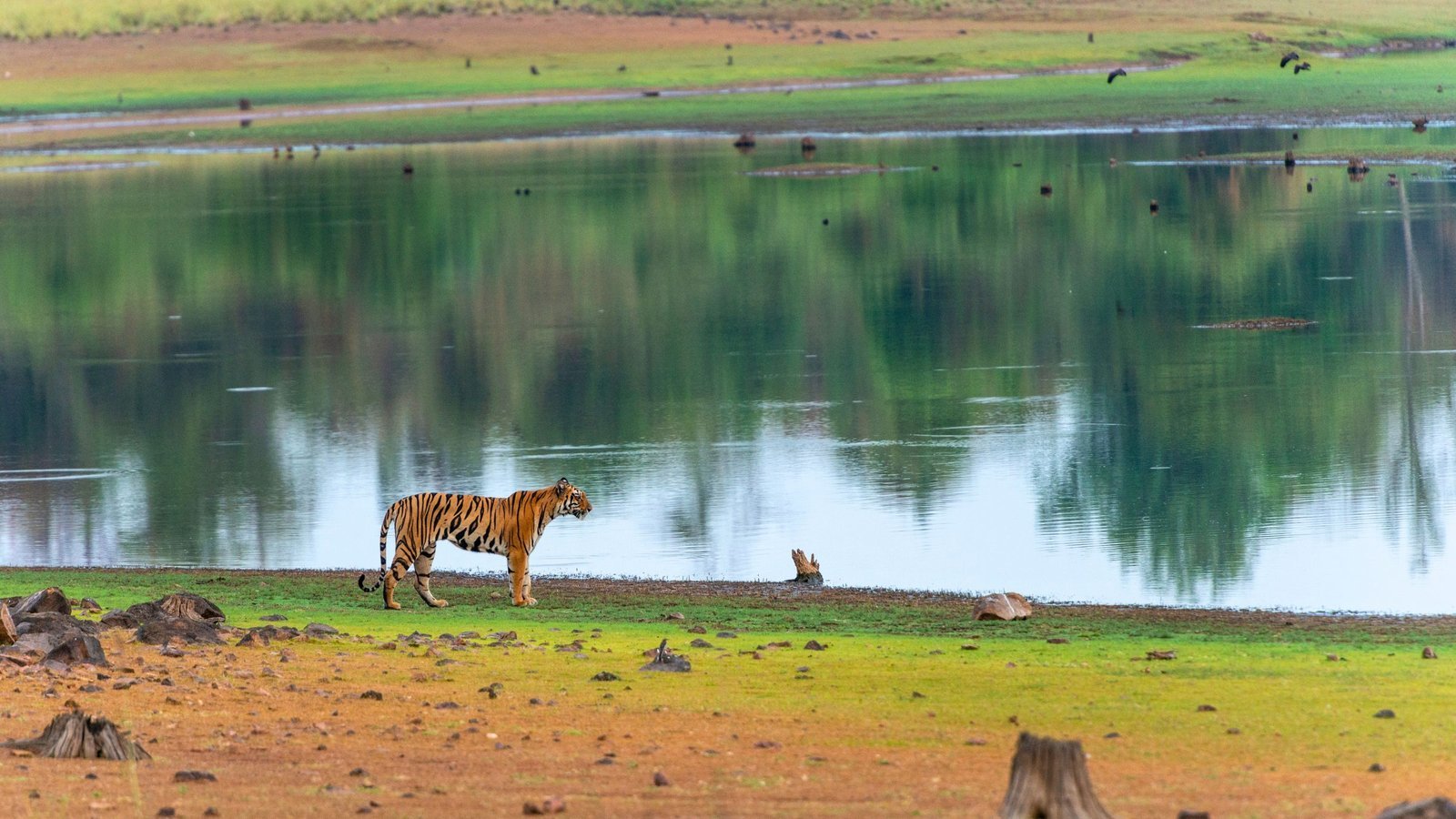
Our guide pointed towards a waterhole a short distance away.
“Sir, tiger.”
I looked in the direction of his outstretched hand, expecting perhaps a fleeting glimpse of a striped animal disappearing into the undergrowth.
Instead, there were four.
A tigress and her three cubs were cooling themselves in the water, seemingly oblivious to the small group of astonished humans watching them.
I cannot remember how long we sat there. I do remember forgetting almost immediately about the heat, the uncomfortable journey and every complaint I had been preparing. Until that moment, wild tigers had largely existed for me in photographs and television documentaries. And here I was, barely minutes into my first Tadoba safari, watching an entire tiger family at a waterhole.
It was an encounter that would change my relationship with wildlife photography and, in many ways, the direction my travels would take over the following years.
That afternoon was my introduction to Tadoba.
Back then, the reserve was far from the celebrated wildlife destination it is today. Over the years, I have watched its reputation grow alongside its tiger population. I’ve seen once-obscure forest tracks become familiar to photographers across the country, individual tigers acquire devoted followings, and the safari landscape expand well beyond the gates we knew in those early days.
Today, Tadoba is among India’s most popular tiger safari destinations. Its rise has been remarkable, and there are several reasons behind it—some rooted in conservation, others in the extraordinary animals that made the forest famous.
1. Thriving Bengal Tiger Population
Tadoba’s growing popularity begins with the success of tiger conservation. Protection of the core forest, management of adjoining buffer habitat, wildlife monitoring and efforts to sustain prey populations have helped the reserve become one of Maharashtra’s important tiger landscapes. The results are visible in long-term camera-trap studies.
In 2010, monitoring photographed 15 individual tigers in a much smaller surveyed area. By 2014, camera traps recorded 65 individuals and estimated 72 tigers in the wider monitoring landscape. A decade later, the 2024 monitoring exercise photographed 95 adult tigers across Tadoba’s core and buffer, with an estimated density of 7.18 tigers per 100 sq km, compared with approximately 5.61 in 2014. The expansion of the surveyed area means the raw counts should not be presented as a direct sixfold population increase; the rising measured density is the more meaningful comparison.
The success is not confined to the core. In 2014, ten tigers were recorded using the buffer exclusively; by 2024 that number had reached 36, with many other animals moving between core and buffer forests. This matters because a tiger does not recognise the administrative boundary separating the two.
For travellers, the result is a remarkable opportunity to observe tigers in an established, functioning ecosystem. You may encounter an animal by a lake, glimpse a tigress moving through bamboo, or spend an entire drive listening to alarm calls without seeing the predator. No count guarantees a sighting, but Tadoba’s conservation story explains much of its reputation among people who travel specifically for wild tigers.
2. The Famous Tigers That Put Tadoba on the Map
Conservation helped Tadoba’s tigers thrive, but it was the stories of individual animals that made the reserve famous far beyond Maharashtra. As digital photography and social media took off, a new audience began following tigers by name. A photograph of a familiar tigress or a young male was not simply another wildlife image: people knew the family, the territory and what had happened in the previous season. For many, those stories became the reason to visit.
The Telia Sisters
Sonam, Lara, Geeta and Mona became known as the Telia sisters. Their unusual behaviour as four young tigresses, including hunting together, made them the subjects of the Discovery documentary Tiger Sisters of Telia, broadcast in India as Girl Gang of Telia in January 2015. The film introduced the individual animals and their lives to audiences who had never been on a tiger safari. Telia Lake and the surrounding forest were no longer anonymous places on a map.
Maya, the tigress everyone knew
Then came Maya, whose life in the Pandharpauni landscape attracted an extraordinary following among photographers and regular safari visitors. People watched her grow up, defend territory and raise cubs. Her story travelled through wildlife photography groups and magazines and reached a wider audience through Aishwarya Sridhar’s National Geographic documentary Queen of Taru (also covered under the title Tiger Queen of Taru). For a period, people planned Tadoba journeys specifically in the hope of seeing Maya—not simply any tiger.
Waghdoh, Matkasur, Chhota Matka and the powerful males
Waghdoh, affectionately known as the Big Daddy of Tadoba, was one of the reserve’s most influential males. Famed for his imposing size and facial scars, he fathered at least 40 cubs, including the Telia sisters with Madhuri, and left a remarkable legacy across the core and buffer forests. His death in 2022 prompted tributes from photographers, guides and wildlife enthusiasts who had followed him for years.
Later, Matkasur became known for his formidable presence in the central forest, while Chhota Matka drew an enthusiastic following among photographers and repeat visitors. Dadiyal is another name associated with Tadoba’s memorable males. Their changing territories and encounters became stories that visitors discussed season after season.
Madhuri, Chhoti Madhu and Junabai: stars of the buffer forests
Fame was never confined to the core. Madhuri, one of Tadoba’s celebrated matriarchs and the mother of the Telia sisters, went on to raise further litters in the Moharli-side buffer forests. Her daughter Chhoti Madhu became a familiar presence in the Dewada–Agarzari landscape, carrying that remarkable family story into another generation. On the Kolara–Madnapur side, Junabai earned a following through repeated sightings and her history of raising cubs. Their popularity showed visitors something important: the forests outside the familiar core safari circuit could produce extraordinary wildlife experiences too.
As camera phones, photography communities and social platforms grew, images of these individual tigers travelled far beyond the forest. People remembered their names, recognised their faces and followed the stories of their families. That sustained attention helped make Tadoba a place visitors wanted to experience for themselves—not because a named tiger could be guaranteed, but because the lives of its wild residents had become stories worth following.
That is one of the less discussed reasons for Tadoba’s success as a destination. Its wildlife acquired a public identity. Photographers wanted to return, followers of those tiger stories wanted to see the places where they unfolded, and first-time visitors arrived already invested in the forest. None of these famous individuals should be presented as a current sighting promise. Their importance is historical: they helped make Tadoba a destination people recognised and wanted to experience.
3. A Large Network of Safari Gates Makes Tadoba More Accessible
Unlike destinations where tourism depends on just a handful of entry points, Tadoba has developed a substantial network of safari gates. Its regular tourism system lists six core gates and sixteen buffer gates, spread around four broad geographical regions: Moharli, Kolara, Navegaon and Pangdi–Zari.
The six core entrances are Moharli, Khutwanda, Kolara, Navegaon, Pangdi and Zari. Moharli, Khutwanda, Kolara and Navegaon provide different approaches into the interconnected central core forest, while Pangdi and Zari serve the more southerly Kolsa landscape. The buffer network adds entry points around these areas, including Agarzari, Junona, Dewada, Adegaon, Alizanza, Madnapur, Kolara Chauradeo, Belara, Navegaon Ramdegi, Nimdela and others.
Why does the number of gates matter to visitors? It spreads tourism across different parts of the landscape and gives travellers a wider choice of safari permits, places to stay and forest experiences. Someone based near Kolara need not travel all the way to Moharli for every drive. If one sought-after gate has sold out, other core or buffer options may still offer an excellent safari experience. The gates are not interchangeable in travel time or permitted routes, and more gates do not mean guaranteed availability, but the wider network makes planning a Tadoba trip more flexible.
The growth of buffer tourism is particularly important. These are real wildlife habitats, not inferior substitutes for the core. At times, Tadoba’s buffers have been among its most productive areas for sightings. They can also offer access in seasons when regular core tourism is closed, subject to the gate and prevailing arrangements. For a closer look at the differences, read our Tadoba core versus buffer guide.
4. Territorial-Forest Safaris Are Opening Up New Wildlife Landscapes
The next chapter in Tadoba-region tourism is taking shape beyond the notified core and buffer of the tiger reserve. Territorial forests are managed forest areas outside the regular reserve tourism system, often forming part of the wider landscape through which tigers and other wildlife move. They should not be confused with an additional Tadoba core or buffer gate.
Safari initiatives in territorial forests have been developed at locations including Karwa and Chora–Tirwanja. A new territorial safari initiative at Shedegaon, in the Bramhapuri Forest Division near Chimur, was announced in December 2024. More recently, a Lohara tourism circuit has been reported for 2026. These areas illustrate how wildlife tourism is beginning to extend into forests outside the conventional Tadoba safari circuit; each has its own management and booking arrangements, and operating status needs to be verified before including it in a trip.
These emerging experiences are significant for two reasons. They draw attention to wildlife corridors and forests beyond the best-known gates, and they can create opportunities for local communities to participate in tourism. They also give repeat visitors another perspective on the wider Tadoba landscape. They are not a shortcut to guaranteed tiger sightings, and they should not be counted among the reserve’s six core and sixteen buffer gates.
5. Convenient Connections from Nagpur, Chandrapur and Major Cities
Accessibility has played a major role in Tadoba’s popularity. Nagpur is the principal air gateway, with flight connections to major Indian cities, including Mumbai and Delhi. It is also an important railway junction. Once in Nagpur, visitors can travel by road towards Kolara, Navegaon or the other Tadoba regions without needing another domestic flight or a long, complicated transfer chain.
Chandrapur is an especially useful railway arrival point for the Moharli side, while routes through Chimur serve northern entrances. The drive from Nagpur varies considerably by destination: Kolara and Navegaon are generally closer to Nagpur than Moharli, and the road journey may range from around two-and-a-half to four hours depending on the exact gate, lodge and conditions.
For people travelling from Mumbai, Pune, Bengaluru, Hyderabad or Delhi, these connections make a two- or three-night wildlife break more realistic. Better road links across Maharashtra have also improved access for travellers who prefer to drive. Rather than committing to a long expedition, visitors can plan a compact holiday with several forest drives and a comfortable stay.
6. Core and Buffer Safaris Offer Different Experiences
Tadoba is attractive not merely because it has many gates, but because those gates lead into varied forest landscapes. Central core drives may pass lakes, grasslands and bamboo thickets; the more southerly forests offer a different character; and several buffer areas support established tiger territories, herbivores and rich birdlife.
There is a common assumption that the core is where all the wildlife lives. Our experience of Tadoba does not support that simplistic view. We have had memorable encounters in the buffers as well as the core, and which area is productive changes as animals move, establish territories, raise cubs or shift in response to other tigers.
That variety appeals to photographers and repeat visitors in particular. Some prefer returning to the same forest to understand an individual animal’s movements. Others enjoy exploring contrasting habitats. Our detailed Kolara and Moharli articles explore their respective landscapes and access points.
7. Tadoba Has Accommodation for Different Budgets and Travel Styles
As visitor interest has grown, accommodation has expanded around the reserve. The choice now ranges from simple homestays and comfortable wildlife resorts to more elaborate lodges. This is another reason Tadoba packages are appealing: the trip can suit a family holiday, a group of friends or a specialist wildlife-photography journey without requiring everyone to book the same kind of stay.
Location still matters. A lodge near the northern gates may be a poor base for repeated early-morning drives in a distant southern sector. Choosing the right accommodation is therefore about more than the number of stars or the swimming pool. It is about being able to enjoy the safaris without spending an unreasonable amount of time travelling between gates.
8. The Reserve Rewards Visits in Different Seasons
Tadoba appeals to visitors at different times of year. Winter brings more comfortable temperatures, particularly for families and first-time safari travellers. Summer can be intensely hot, but water sources and changing vegetation make it a distinctive season for wildlife observation. During the monsoon, the forest becomes lush and some buffer tourism can continue even when core safari operations are closed.
There is no universally perfect month and no season that guarantees a tiger sighting. The attraction is that the forest offers different experiences across the year, and travellers can choose between comfort, dramatic seasonal landscapes and a more focused wildlife journey.
9. Tadoba Packages Fit Short Holidays as Well as Longer Safaris
For many travellers, the final reason is simple practicality. A two-night stay can accommodate several safaris when arrival, departure and permits align; three or four nights allow more time in the forest. Packages bring accommodation, meals, permits and ground transport into one coordinated itinerary, with inclusions varying according to the chosen programme.
The value of a package is convenience—not privileged access to tigers. The safari itself remains subject to forest rules, availability and the unpredictability of wildlife. For those deciding how much time to allow, our article on two, four or six tiger safaris explains the trade-offs.
Why Has Tadoba Become Such a Popular Safari Destination?
It is the combination that matters: conservation has helped sustain a thriving tiger landscape; six core gates and sixteen buffer gates distribute access across the reserve; territorial-forest initiatives are bringing attention to the wider wildlife landscape; Nagpur and Chandrapur make the destination relatively easy to reach; and a wide choice of stays makes it possible to build anything from a short family holiday to a longer photography trip.
Tadoba’s popularity has not been created by a single famous tiger or one exceptional gate. It has grown because the forest is rich, the tourism network is extensive, and the destination is accessible to people who want to experience wild India for themselves.
Frequently Asked Questions
How many safari gates does Tadoba have?
The regular reserve tourism system lists six core gates and sixteen buffer gates. Territorial-forest safari circuits outside the notified reserve are separate initiatives and are not included in that count.
Are buffer safaris worth booking in Tadoba?
Yes. Buffer forests support tigers and other wildlife, and sightings can be excellent. Their value depends on season, habitat and animal movement rather than the administrative label alone.
Which airport is closest to Tadoba?
Nagpur is the principal airport for Tadoba. The onward drive depends on which gate and lodge you are visiting.
Is Tadoba suitable for a weekend safari trip?
For travellers who can reach Nagpur conveniently, a two-night stay can work well. The number of possible safaris depends on travel timings, permits and weekly gate closures.
Are territorial-forest safaris the same as Tadoba buffer safaris?
No. Territorial-forest initiatives operate in forest landscapes outside the regular notified core and buffer tourism system, with separate permissions and arrangements. Their operating status should be confirmed before planning travel.